The Art of Deception 14 #wewriwar #amwriting

The Art of Deception

or Pride and Extreme Prejudice

12241791_735836876546522_6197947469406170479_n

Welcome to Weekend Writing Warriors. This week continues a spy story set in late Georgian England, the year before Trafalgar. We’ll leave Roderick with the Clinton’s in New York as he awaits his packet home (were this set in Victorian times we’d say he was “working his ticket”) and pick up with Alice. Alice is in training at Mrs Hudson’s academy in Chipping Sodbury, and in trouble.


A month into training, Alice was busily sweeping the front steps when new friend Lucy interrupted her, “Alice, the head wants to see you.”

“What have I done now?”

Lucy shrugged, “Does it have to be bad?”

“Hasn’t been good yet,” She gave Lucy the broom and walked into the building, up the front staircase and down the now all too long hall to Mrs Hudson’s room. It seemed like her steps echoed behind her without stopping.

“Close the door behind you and sit down,” Clearly Mrs Hudson wasn’t amused, “Alice I am glad to see you understand your lessons in concealed communications.”

“You are?”

“Yes. However, you will not apply them on your letters home.”

“Oh, It’s just I thought mother would -”

“You didn’t think; that’s the problem,” Mrs Hudson handed her yesterday’s missive, “Make a clean copy.”

Please see the other talented writers in Weekend Writing Warriors.


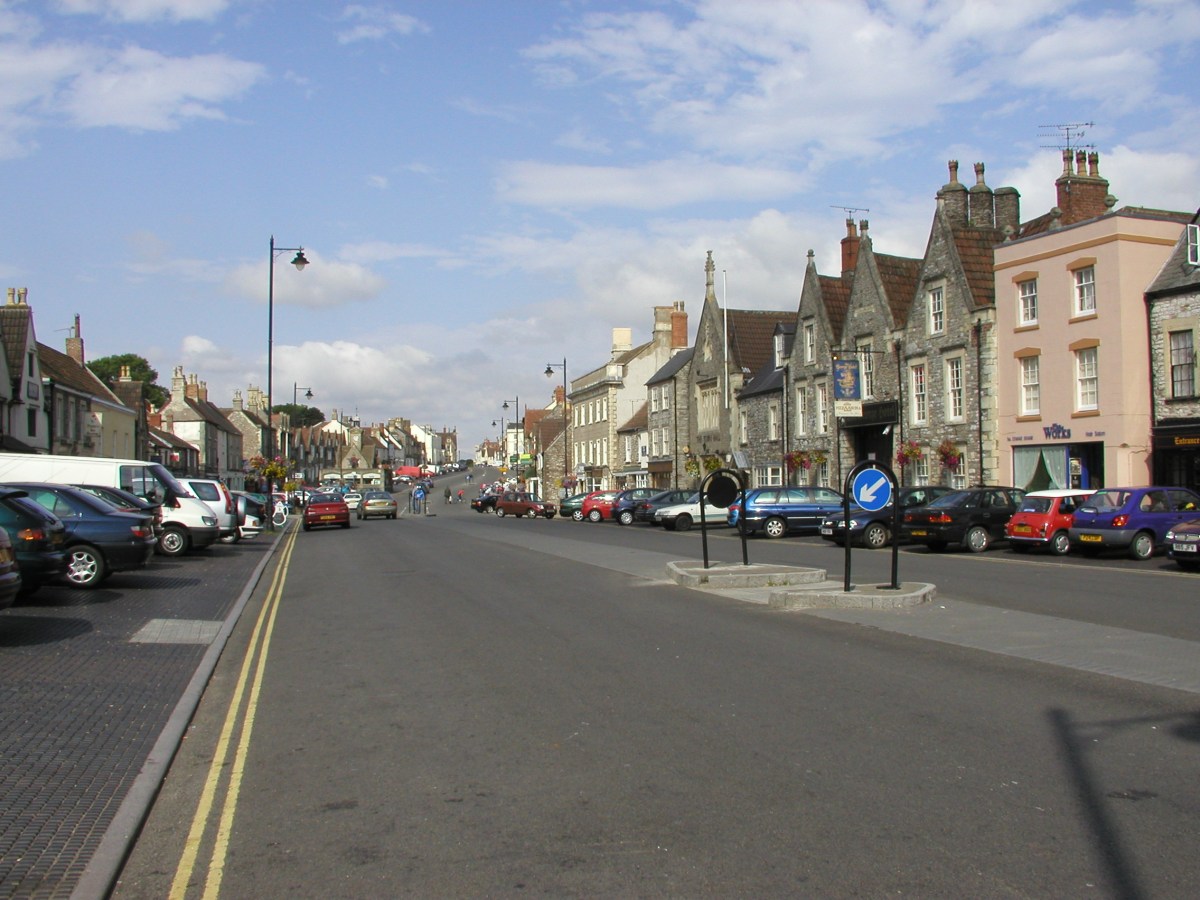
The cover image is Chipping Sodbury in 2004. This broad street was the market in the 19th century. Mrs Hudson’s academy was down a side street, to the right in the picture.

I’ve released a sweet regency romance, Miss DeVere Miss_devere_1 This is a fun read, and unlike “The curious profession of dr craven THE CURIOUS PROFESSION FINAL” seems to not carry a curse. However, Dr Craven is on sale this week.

Frankenkitty is available.
Frankenkitty What happens when teenagers get to play with Dr Frankenstien’s lab notebooks, a few odd chemicals and a great big whopping coil? Mayhem, and possibly an invitation to the Transylvanian Neuroscience Summer School.
Booktrope shuts it’s doors May 31. This opens a whole slew of questions, including whether to return to an earlier pen-name (R. Harrison being dead common.) It also means that come June 1, the current version of “The curious profession of dr Craven.” will be unavailable. I will get the rights back without trouble. (Although there are issues about ‘creative teams’ that still need to be settled.)

The Art of Deception 13 #wewriwar #amwriting

The Art of Deception

or Pride and Extreme Prejudice

12241791_735836876546522_6197947469406170479_n

Welcome to Weekend Writing Warriors. This week I continue another book, that will now won’t come out via booktrope (they’re shutting down). It’s a spy story set in late Georgian England, the year before Trafalgar. We’re following Roderick, Lord Fitzpatrick for the moment. Last week found Lord Fitzpatrick in New York as consol pro tem and landed in a sticky situation. The governor of New York, George Clinton, and his cousin the mayor of the city, summon him to make an official complaint. For what it’s worth neither Hillary nor Bill are related to George and DeWitt.


The secretary led him to a front parlour where the Governor, George Clinton, and the Mayor, his cousin DeWitt Clinton waited. George, consistent with his age and looming infirmity remained seated when Roderick entered. He was still an impressive figure, white haired and almost regal. DeWitt was younger, in his forties, and like his older cousin an experienced and skilled politician and diplomat. Both had fought in the revolution, and neither were inclined to be friendly to British interests.

DeWitt started off, “Ah, Mr Fitzpatrick, glad you could make it.”

“As His Majesty’s representative in the city what else could I do; I presume this is about the Leander.”

The older man said, “Intolerable interference with the commerce of our state and city … we saw your lot off in ’83 and will do it again.”

“I have communicated your objections to Mr Merry in Washington in an express, and will escort the diplomatic communications to London on the next packet … may I add my personal observation that our navy’s actions are stupidly and unnecessarily provocative?”

“You may, but it doesn’t matter, does it?”

Please see the other talented writers in Weekend Writing Warriors.


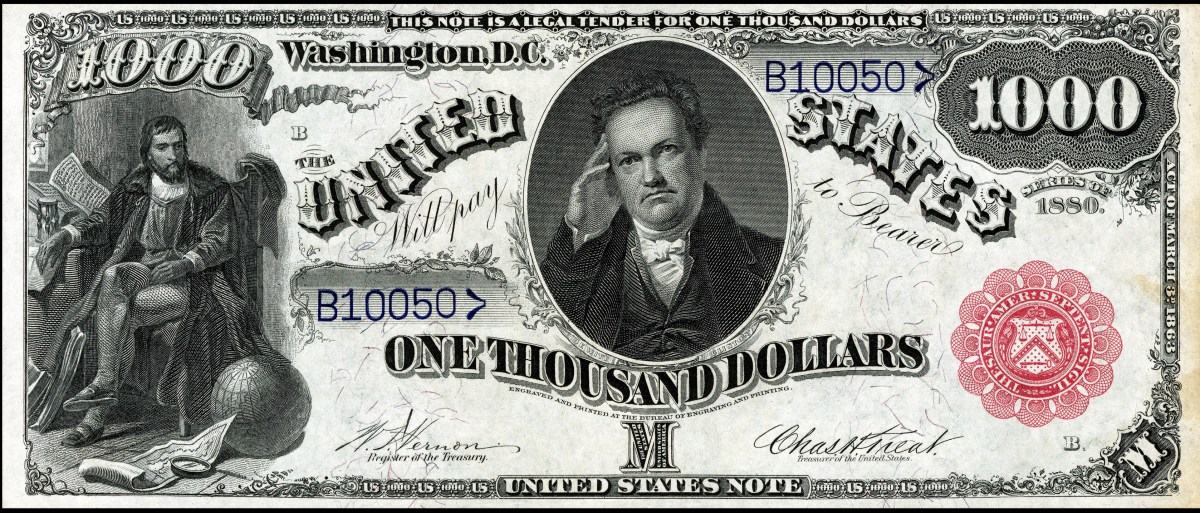
The Clinton’s were major politicians at the time. George Clinton was a leading light in the Democratic-Republicans (Today’s Democratic party). He came out of retirement specifically to keep Colonel Burr from becoming governor of New York. Neither of them was a fan of slavery, and their opposition to it is part of why we didn’t have a ‘President Clinton’ in 1812. They were also important factors in introducing manufacturing and technology to the Northeastern United States. Their insistence on rebuilding harbour fortifications is a major reason that the British did not burn or occupy New York in the war of 1812.

That’s DeWitt Clinton on the 1880 thousand dollar bill.

Booktrope shuts it’s doors May 31. This opens a whole slew of questions, including whether to return to an earlier pen-name (R. Harrison being dead common.) It also means that come June 1, the current version of “The curious profession of dr Craven.” will be unavailable. I will get the rights back without trouble. (Although there are issues about ‘creative teams’ that still need to be settled.)

I’ve also released a sweet regency romance, Miss DeVere Miss_devere_1 This is a fun read, and unlike “The curious profession of dr craven THE CURIOUS PROFESSION FINAL” seems to not carry a curse. However, Dr Craven is on sale this week.

Frankenkitty is available.
Frankenkitty What happens when teenagers get to play with Dr Frankenstien’s lab notebooks, a few odd chemicals and a great big whopping coil? Mayhem, and possibly an invitation to the Transylvanian Neuroscience Summer School.

Get Free Stuff and try out my landing page. There are three free complete short stories (including an ARC for Frankenkitty) available after you’ve gone through the hoops.

The Art of Deception 12 #wewriwar #amwriting

The Art of Deception

or Pride and Extreme Prejudice

12241791_735836876546522_6197947469406170479_n

Welcome to Weekend Writing Warriors. This week I continue another book, that will now won’t come out via booktrope (they’re shutting down). It’s a spy story set in late Georgian England, the year before Trafalgar. We’re following Roderick, Lord Fitzpatrick for the moment. Last week described the immediate consequences of his practical abolitionism. He’s in New York this week, having fled Washington. Unfortunately the British consul has decamped with a local beauty and instead of taking his ease while waiting the monthly packet, he is pressed into service. He’s also been landed dab in the middle of a diplomatic crisis brought about by an overzealous Captain. He’s dressing down a midshipsman in this section.


“What was your Captain thinking? Assuming he is capable of thought. Chasing a merchantman into New York harbour and then firing on her; let alone killing the helmsman – a Mr Pierce. There were riots in the streets yesterday.”

“She didn’t stop when we hailed her … the ball hit a different ship, the sloop Richard.”

Roderick rose and escorted the young sailor to the front window of the British Consul’s house in Brooklyn; the tip of Manhattan was visible, across the river, “Do you see that? The battery … the blasted Jonathans are rebuilding it … all the harbour defences … it’s now only a matter of time before we’re at war.”

The midshipman nodded, “How many guns?”

Roderick said, “It’s in the letter ;I know he won’t but I’m demanding that Captain Whitby leave; he’s causing more harm to the crown by stopping ships than the contraband he confiscates could ever do; you’re already banned from resupplying in any United States port.”

“Halifax isn’t far.”

Roderick quietly ground his teeth in frustration, “Why couldn’t the admiralty see that they were driving the American’s straight into the willing arms of the French? “

Please see the other talented writers in Weekend Writing Warriors.


The date is shifted, but they are discussing the Leander affair. The British Navy stationed two warships outside New York harbor and intercepted American merchant ships. The ships were searched for contraband and often taken to Halifax as prizes. Eventually even the tax-averse Democratic-Republicans had to rebuild the navy and chase them away. Roderick is right, war with the Americans was only a matter of time after that.

Booktrope shuts it’s doors May 31. This opens a whole slew of questions, including whether to return to an earlier pen-name (R. Harrison being dead common.) It also means that come June 1, the current version of “The curious profession of dr Craven.” will be unavailable. I will get the rights back without trouble.

I’ve also released a sweet regency romance, Miss DeVere Miss_devere_1 This is a fun read, and unlike “The curious profession of dr craven THE CURIOUS PROFESSION FINAL” seems to not carry a curse. However, Dr Craven is on sale this week.

Frankenkitty is available.
Frankenkitty What happens when teenagers get to play with Dr Frankenstien’s lab notebooks, a few odd chemicals and a great big whopping coil? Mayhem, and possibly an invitation to the Transylvanian Neuroscience Summer School.

Fort Pulaski, shown as the cover image, is a third generation coastal defense fort. I don’t have any pictures of Battery Park or Fort McHenry in Baltimore, which are second generation forts built at the time of the story.

Get Free Stuff and try out my landing page. There are three free complete short stories (including an ARC for Frankenkitty) available after you’ve gone through the hoops.

A Formulaic Romance, Chapter 5. #amwriting #wip #romancenovel #fridayreads

Mr Oliver or Harding or whatever has his revenge in this chapter. Armed with a barely legal warrant, he and General Byng search the hall, trashing it in the process. To make matters worse, George’s fiancee shows up. She’s worried about him and brings along his mother, the redoubtable Lady Beddlington.  Lady Beddlington does not approve of Rachel.

It continues from the previous chapter, or you can start from the beginning.

My co-author Amelia and I often put the beginnings of books on my, now our, blog. They don’t always make it to the end, but it’s helpful for our writing. This is another Regency Romance. This time without grave robbing or financial dealing and legal chicanery.

Consequences.

George’s confidence about seeing the last of Mr Oliver was sadly misplaced. The door knocker banged early in the morning, echoing through the house. Mr Brindle hurried to answer.

A man in a General’s uniform spoke, “Took you long enough.” He stood with a small squad of men and more importantly, Mr Oliver.

“Sir?”

“Call your master.”

“As you desire. Would you care to wait in the hall?”

“No. We’ll stay here.”

“As you wish. I shall summon Lord Hartshorne.” Mr Brindle turned and entered the building. Unfortunately it meant that he missed seeing the General motion to his soldiers. The squad double-timed as they placed guards at all of the doors and in places where they could watch the ground floor windows.

A minute later Mr Brindle shuffled into the parlour where Rachel was breakfasting, “Ma’am.”

“Yes?”

“There are some gentlemen at the front door, Ma’am.”

“What about them?”

“They desire to see Lord Hartshorne, and I thought it best if you were aware. It might … be useful to have you there.”

A bleary-eyed and hastily dressed Rupert stumbled outside fifteen minutes later followed by Rachel and George. “Good morning General Byng,” he said, “What brings you to Oulten Hall so early on such a fine day?”

“Nothing good My Lord. Information has been laid that you are in possession of a large amount of explosive material. Unauthorized and illegal possession, I might add.”

Rupert scanned the men who remained in front. Mr Oliver was grinning. Rupert said, “Stuff and nonsense.”

“We shall see. Put it to the test with a search. Can’t have the revolutionaries getting their grubby hands on explosives. Bad enough if they have pitchforks and shotguns.”

“No you won’t.”

“I’m afraid this.” General Byng produced a sheet of paper that was adorned with a seal, “this is a search warrant. Not that we need it, but best to obey the formalities. Stand aside, Sir, while we search your dwelling.”

George demanded, “Let me see it.”

General Byng nodded to a soldier and with that, the man carried the document to him. George scanned it. “It’s not legal. Sir John should-”

Legal or not, George’s pronouncement had little effect. General Byng nodded to his command and was followed by the men when he charged inside. Mr Oliver gave George a slight bow, smiled at Rachel and followed. The men made their way from room to room, leaving little intact. The stuffed animals, mostly intact, joined piles of books, papers and journals in haphazard chaos on the floor in the library. The destruction was near total. Only the skeleton in the corner stood, though he was shorn of his drapery.

One of the soldiers said to General Byng, “Not here, Sir.”

“Next room then.”

Seizing Rupert’s small sample of sodium from the shelf in the parlour, one of the men dumped the oil on the floor. Thinking it valuable, he put the metal in his pocket. He then discovered the hard way, when his trousers caught fire, that sodium was not to be held close to delicate areas[1]. Heading off their intention to quench the fire with a jug of water, Rupert managed to retrieve the metal before either the trousers or the man was burned too badly.

Rupert interrupted General Byng, “If you would tell me what you are looking for, I might save this destruction.”

“We’ll known when we find it.”

“So the destruction is the purpose of this search?”

“You might say that, but I’ll deny it.” There being little else to tear apart, they moved on to the next room. Screams echoed up from downstairs. Rupert’s cook defended her domain with more ferocity than her looks suggested.

Eventually the path of destruction wended its way to the Rupert’s workshop. Rupert stood in the door, blocking it. “No. Please. There are things in here that.’

His objections were of little avail. His next words, “Are dangerous if not handled right,” were ignored.

General Byng laughed, “Move him aside, Lad’s. If it’s not here, then he’s clean.”

Rupert struggled against the two men who held him while the rest filed in and started tearing his laboratory apart.

Meanwhile, Mr Oliver sidled up to George and Rachel. He drew a quiet breath, and expressed his unctuous concern, “Would have been cheaper to settle you know. Easier.”

“Never. You’ll hear from my solicitor, and Lord Hartshorne’s one.”

“Fat lot of good that’ll do you. M’Lord. I have Lord Sidmouth’s ear. The shining golden boy who can do no wrong, I am. Especially when there are so many dangerous reformers loose in the countryside.”

Rachel spat, “At least for the moment.”

Mr Oliver gave her a stiff bow. “That’s all it will take. Ma’am.”

An explosion, followed by screams, interrupted their conversation. Not that it was a flowing or enjoyable one in any case. One of the soldiers found a small box, labelled, “Explosive, do not disturb.”

It contained samples of Oxymuriate of Potash mixed with flowers of Sulphur, and various similar fulminating or detonating mixtures. Chemicals that would ignite or explode with little provocation.

He shouted, “Here Sir, we’ve got it,” to General Byng.

“Open it and see.”

Rupert tried one last time to intervene for their safety. He shouted, “Please don’t. It contains sample detonators. A long term study of their stability. They could.”

It was too late. The soldier opened the box and picked up one of the fulminates. It still worked three years after Rupert had made it. Unfortunately, it was more sensitive than the original preparation and blew the man’s hand to shreds when he handled it roughly and held it up.

Years of war had inured General Byng to wounds and screams. He turned to the men holding Rupert and said, “He’s under arrest. We’ve found what we need.” Then he turned to the others and said, “See what you can do for poor Lewis, and have that man be quiet. Poor discipline.”

The men frog-marched Rupert off to await his trial. Red drops of blood showed where Lewis walked as he limped after them.

Rachel looked at the destruction, watched the men escort Rupert off, and started to sob. Quietly, but definitely.

George patted her, perhaps too familiarly, on the back and then said, “I’ll follow them. See what I can do. Habeas Corpus is still in effect, despite what General Byng says. I’ll find a magistrate.”

“You will?”

“Yes, now dry those tears. Keep busy and try not to worry. You know and I know this was a low attempt at revenge. It will be fine. Worse comes to worse, I’ll send an express to the General’s cousin Poodle. He’s well connected, something to do with the F.O.”

Rachel nodded her agreement. George headed for the stables, which consistent with his statement about revenge, were untouched. Even though they’d be an excellent place to store explosive compounds or gunpowder.

Rachel headed for the library. She would start on the books. Unlike many of the servants, she could easily read the titles.

****

Rachel was standing in the diminishing pile of books, like Dido in the remains of a literary Carthage, when a carriage pulled up outside of the Hall late in the afternoon. While the maids and footmen had repaired much of the damage, the chaos of the morning was still evident when two stylish women strode into the library, leaving their servants to handle the mundane details. The elder of the two, a ferocious looking woman in her middle years, snapped her fingers and said, “Tea,” before she dusted off a chair and sat down, rigid in her disapproval. The other, an elegantly dressed young woman who was close to Rachel’s age, added, “What are you waiting for? Tea. It was a tedious journey and we are in need of refreshment.”

Seeing that the bell pull was still torn from its wire and feeling the desperate need for a change of scene Rachel left them and found Mrs Hobbes. “If it wouldn’t be too much trouble, Mrs Hobbes, our visitors would like tea … in the library. Are there still three cups intact?”

Despite the carnage that lay around them, Mrs Hobbes retained her humour. She smiled when she said, “Not from the best set, Ma’am, but they’ll do for this company.”

“Thank you.” Rachel returned to the library and continued restoring books to their shelves. She picked up the first of several bound notebooks. They were in Rupert’s hand, his laboratory notes; copied gracefully and clearly so that his experiments could be repeated. While she studied them, wondering what he meant by Sal. Nat. or Cinnabar and nitric spirits or for that matter what it meant to reflux, Mrs Hobbes came in with the tea tray. She put it on a table, then quietly bowed to the two women. “Ma’am,” she said to Rachel, “your tea.”

“Thank you Mrs Hobbes.”

Rachel sat across from the two women and poured the tea. “I’ll be mother.”

The older one, her brown hair starting to be streaked with grey, and wearing the minimal bonnet of a dowager on the make, frowned, “A servant, drinking tea with her betters. Rupert must learn to enforce proper deference in his people.”

The other one, much prettier and younger, with blonde hair, an elegant necklace, and a fine lace collar above her muslins added, “Lady Beddlington, I’m sure she could use the refreshment. We must excuse excesses when there has clearly been a cataclysm of no small magnitude. Whatever happened here?”

Rachel inspected them, “Lady Beddlington? George’s mother … and you must be Miss Deacon. I’m Lady Hayforth. I’m so pleased to meet you. We’re soon to be related.”

“We are?”

“I suppose, well with the short time, and … this upset. Rupert hasn’t had time to compose a letter. But”

“Oh My Lord, you’re not engaged to my grandson?”

“We haven’t negotiated the settlements yet, but yes. Rupert offered me his hand, and I accepted the honour … with great pleasure. It’s made both of us so happy.”

Lady Beddlington put her face in her hands. A minute later, when she finally had composed herself, she raised it to confront Rachel and say. “Where is my foolish grandson?”

“And my fiancé for that matter?”

“I wish I could tell you. General Byng’s men searched the Hall this morning. They took Lord Hartshorne away and George followed them to see what he could do.”

“I wish you would not be so familiar with my fiancé Ma’am.”

“I apologize, Miss Deacon, but he asked me to call him that … as a friend.”

“As a friend? Most unsuitable. I shall have to remind my dearest to keep his distance. It’s a besetting sin of his.”

“I’d say it’s charming. May I ask why you’re here? We were hoping to travel to London soon. My cousin, Lord Bromley, expects me.”

“George, I mean Lord Beddlington didn’t say anything about you or you and Lord Hartshorne in his last letter. I can see why.”

“Miss Deacon … as much as I count your fiancé as a friend, he is simply that, a friend.” Only a friend, yes, only a friend. “If you’re concerned, my companion, Miss Holloway can reassure you on that point.”

“You have a companion? Here.”

“Of course. I was on my way to stay with my cousin, for the season, when my carriage broke. Lord Hartshorne graciously,” Not so graciously at first, “offered us shelter.”

“That wretched pile, on the main road, was that your carriage?”

“Unfortunately, yes. I think our plan is to take Lord Hartshorne’s carriage. At least I hope it is, because his is incomparably nicer.” Rachel smiled at the thought.

“Dirty dishes!” Lady Beddlington leaned forward and exploded, “You baggage, you adventuress. Attaching yourself to my grandson. I’ll see that you don’t wed him.”

Rachel bit her tongue to avoid rising to the argument. Instead of giving Lady Beddlington a piece of her mind, she rose, stiffly, and after nodding to her said, “I must see to these books, Ma’am. These,” she pointed at the bound notebooks, “are his laboratory notes. I’m sure he’s most worried about them, and one seems to be missing.”

Eventually, tired of being ignored and of enduring her intended mother-in-law’s sputtering temper, while equally curious about the contents of Lord Hartshorne’s library, Miss Deacon rose. She knelt beside Rachel and said, “May I help?”

“Thank you, I’d love help. I’ve been sorting the books by author.” She pointed to the piles, “It’s a long process.”

“I see.” Miss Deacon picked up the ill-fated volume of Kant’s critique. “This is in the original German. I received Geo- Lord Beddlington’s answers to my questions. Most insightful. I didn’t know he had it in him, not to mention that he could read academic German … what are you sniggering at?”

“Nothing. He and Rupert, um, they worked together on your questions.”

“Oh. At least he was improving his mind.”

Lady Beddlington fiddled with her reticule, pulled out her fan, opened it and fanned herself, then shut it with an echoing snap. “Cha- Miss Deacon, I am distressed sitting here. Escort me to my room. I have a headache.”

“Yes, Lady Beddlington,” Charity started to rise, but Rachel was quicker. She curtsied, “My Lady, let me call my companion, Miss Holloway.  She’s an excellent nurse and very skilled at relieving headaches.” Poor Lucy. Lady Beddlington started to object, so Rachel continued, “I should so much like to know Miss Deacon better.”

“Maybe you’re right … Miss Deacon do not over tax yourself. Remember you’re not strong.”

“Yes, Ma’am.”

“If you’ll let me assist you.” Rachel added, “I’ll help you to the hallway and we’ll find my companion.”

A few minutes later, having safely delivered Lady Beddlington to Lucy’s care, Rachel returned. She asked, “What did Lady Beddlington mean by ‘you’re not strong?’ You seem healthy to me.”

“I don’t know. Maybe she thinks Geor- Lord Beddlington would enjoy a languid wife.”

“The George,” Rachel saw Miss Deacon stiffen, “The George I know wouldn’t. Let’s not pull caps, we should be cater-cousins. May I call you Charity? Much nicer name than mine, Rachel.”

“Ewe may.”

“Thank you.”

“I punned just then. Did you catch it?” Charity saw from Rachel’s confused expression that she didn’t. “The word Rachel means ewe, or ewe-lamb.”

Once the joke was explained to her, Rachel laughed, “I’m even gladder now that my father didn’t pick Delilah or Jael. No scholar, He just read the Old Testament to find one he liked – thought it would demonstrate his piety. Not that he really had any.”

“Delilah’s queen of the night and Jael mountain goat.”

“Then I guess Rachel’s not too bad of a name. Charity, at least that’s an English word.”

“Don’t you know Hebrew?”

“No. My education rose to Fordyce’s sermons and the house books. No more.”

“Poor girl. I’m helping George, my George, to remedy the defects in his education. Would you like to join us?”

“Very much.”

****

Supper was over by the time George and Rupert returned from General Byng’s camp. They stumbled into the front parlour, tired and dishevelled. Definitely in need of a restorative brandy, or two, or maybe three.

George was the first to speak, “Charity?”

“I was worried, you didn’t write.”

“I did, and we were planning to return to the village soon. Sorry if I missed a day or two with the excitement, but you mustn’t worry.”

“Four days.”

“That can’t be. I just sent you my answers to your questions about Kant’s philosophy.”

“Your answers? I heard that Lord Hartshorne helped you, practically wrote the answers for you.”

Lady Beddlington added her mite as well, “Your conduct has been most unsatisfactory, George. The Hall a mess and I find my grandson engaged to be married to an adventuress.”

“She’s not an adventuress, Mother. She’s a,” he caught himself before he said lovely, “well-behaved young woman who will be a credit to our family.”

“I’m surprised and upset. Why Miss Deacon could be within her rights … I mean keeping such low company and encouraging your nephew.”

George could see Rachel’s face whiten at the implied insults. Rupert missed it. Still he said the right things, “I say, you’ve done a fantastic job putting things to right Rachel. It can’t have been easy.”

“It wasn’t, but you really should thank Miss Holloway and Mrs Hobbes. I put books away in the library, with Charity’s help.”

Charity smiled at Rupert, “What an impressive collection you have, and they were read, the spines cracked.”

“Of course, what good’s a book if you don’t read it?”

“That reminds me,” Rachel said, “It looked like one of your notebooks was missing. I found a volume 8 and volume 10, but no volume 9.”

“Really? That’s odd. Must have been misplaced. Look for it in the morning. George, I know it’s not done, but I feel the need of something stronger than tea. Then if Miss Holloway and Lady Hayforth are able to accompany us, I should like to look at the stars. There were some moments today when I wasn’t sure I’d see them again.”

George laughed, “Gas, O yea of little faith, trust your Uncle Beddlington to fix things. I won’t say no to that restorative.”

Charity’s gaze glanced from Rupert to George to Rachel and then back to Rupert. “I’d like to see the stars too.”

[1] A friend of mine at university did this. He thought a small amount of sodium, ‘borrowed’ from his organic synthesis lab, would be useful for a prank. He was OK. Needed a new set of trousers, though.

The Art of Deception 11 #wewriwar #amwriting

The Art of Deception

or Pride and Extreme Prejudice

12241791_735836876546522_6197947469406170479_n

Welcome to Weekend Writing Warriors. This week I continue another book, that will eventually come out via booktrope. It’s a spy story set in late Georgian England, the year before Trafalgar Last week, Roderick Lord Fiztpatrick’s story continued. He proposed to demonstrate some practical abolition. This week describes the immediate consequences of his actions.


The British Minister was summoned to the President’s House the next morning; Captain Lewis met him, and he was not pleased.

“Where is Lord Fitzpatrick?”

“Lord Fitzpatrick, may I enquire why you wish to see him?”

“Someone burned down the slave pens at the Yellow House; thousands of dollars of property has gone missing, vanished into the night.”

“It has … What possibly could this have to do with him?”

“One of the chattel who disappeared was the wife of his servant; Mr Jefferson wanted her out of the President’s House; we also found the remains of a phosphorus jar … it was used to start the fire.”

“Indeed, I still fail to see how that is relevant,” Mr Merry was a master of obtuseness. It stood him in good stead, especially in times like these.

“Isn’t it obvious?”

Mr Merry stared at him, and completely missed his point; again he said deliberately, as he was being annoyingly obtuse and enjoying it, “That reminds me, we’re looking for a housekeeper … you wouldn’t know of one who is available?”


Please see the other talented writers in Weekend Writing Warriors.


Both Robey’s Tavern and the ‘Yellow House’ were notorious examples of slave pens. They were roughly located where the FAA offices and/or the Air and Space Museum are today and were in plain sight of both the White House and the Capitol building. While the white Southerner’s claimed that slavery was natural and good, a real benefit to mankind, it is interesting to note that the documentation about its practice is sketchy at best. Even the ‘fire breathers’ weren’t proud of it in the end.

On a non-literary note, one of my students, Brendan Benshoof, just defended his Ph.D. Tuesday. It’s been a flurry of activity (to be honest, a blizzard of activity) getting the last little bits of papers and dissertation complete before he takes off for a job at Google.

I’ve also released a sweet regency romance, Miss DeVere Miss_devere_1 This is a fun read, and unlike “The curious profession of dr craven THE CURIOUS PROFESSION FINAL” seems to not carry a curse. However, Dr Craven is on sale this week.

Frankenkitty is available.
Frankenkitty> What happens when teenagers get to play with Dr Frankenstien’s lab notebooks, a few odd chemicals and a great big whopping coil? Mayhem, and possibly an invitation to the Transylvanian Neuroscience Summer School.

Get Free Stuff and try out my landing page. There are three free complete short stories (including an ARC for Frankenkitty) available after you’ve gone through the hoops.

The Art of Deception 10 #wewriwar #amwriting

The Art of Deception

or Pride and Extreme Prejudice

12241791_735836876546522_6197947469406170479_n

Welcome to Weekend Writing Warriors. This week I continue another book, that will eventually come out via booktrope. It’s a spy story set in late Georgian England, the year before Trafalgar Last week, we left Alice to her Uncle Grey’s tender mercies. This week we resume Roderick, Lord Fitzpatrick’s story. He’s just told his African American manservant that he is returning to England, but that he has arranged for his servant’s wife to be freed. There is a complication.


“They’re sending her South.”

“Bugger it! Where, when?”

“Today, she’s in Robey’s warehouse, chained; auction tomorrow.”

“Robey’s tavern?”

“Either that or the Yellow House next door.”

Roderick paused, while he claimed crude methods were beneath him, there were times, and this was one of them, that they were appropriate, “Thomas, I think a change of garment is in order; lay out the gentleman’s ken cracking clothes; I’ll need my screws, the phos bottle and … whatever happened to my jemmy, by the way?”

“I was visiting Hannah.”

“Thought as much; that was a tad sloppy of you; if you’d see that our mounts are ready, and I’ll need a light travelling bag packed; can Hannah ride?”

Please see the other talented writers in Weekend Writing Warriors.


The cover image shows a map from 1856 that shows the scene of the action. The Smithsonian, wasn’t yet there.

I’m on a trip to Tybee Island and may be a little late at replying.

I’ve also released a sweet regency romance, Miss DeVere Miss_devere_1 This is a fun read, and unlike “The curious profession of dr craven THE CURIOUS PROFESSION FINAL” seems to not carry a curse.

Frankenkitty is available.
Frankenkitty> What happens when teenagers get to play with Dr Frankenstien’s lab notebooks, a few odd chemicals and a great big whopping coil? Mayhem, and possibly an invitation to the Transylvanian Neuroscience Summer School.

Get Free Stuff and try out my landing page. There are three free complete short stories (including an ARC for Frankenkitty) available after you’ve gone through the hoops.

Follow my blog with Bloglovin

The Witch #WriterWednesday

This is the start of a science fiction story I’m developing.

The Witch, a short story.

The good witch of the west arrived from the air in a bubble.

Farmer Giles was the first to see her. There was a clap of thunder, despite the clear blue sky, and when he looked up there she was. She rode down to him, dressed like a man but in shining silver, suspended under a silken bubble. She stumbled when she landed in the field next to him. He’d just finished plowing a quillet, and was turning his team for the next when it happened.

She removed the clear ball from her head, and put it on the ground next to her. The wind caught her silk and she was struggling with it, when she said to him, “I say, farmer. Can you help me with this?”

“I don’t speak French, can you speak English?”

She didn’t understand him either, so she tried again speaking one word at a time, “Can, you, help, me, please?”

He shook his head. It still didn’t make sense.

She managed to pull the silken bubble together into an awkward mess, and said, “First rule of survival is to never leave anything behind. You never know when you’ll need it.” She turned to the farmer again and tried once more, “Is there a village or town nearby?”

“Village, I know that word.” Farmer Giles said, then he pointed to the valley where a small cluster of thatched wattle and daub houses clustered around a stream. Smoke rose from the houses and filled the valley where it was trapped by a thermal inversion.

Understanding his gestures rather than his words, the witch bowed and said “Thank you.” After gathering her parachute into a rough bundle, she started to walk towards the village. It wasn’t easy for her to walk. The unwieldy parachute, awkward silver clothing and a decided limp from a twisted ankle, made her progress painful.

She hadn’t walked far, when the Lord of the manor’s youngest son rode up. He was followed by a squire. A handsome black-haired man, he was back from the university during the break between terms. Taking advantage of his time away from the drudgery of his studies and the ferocity of the professors, he was hunting with his falcon and saw the witch land.

He said, “Who are you?”

“What did you say?”

“Oh you speak the high language.”

“Your pronunciation is strange, but at least I understand you. Can you tell this idiot to help me?”

“Giles is not an idiot. He’s sound man, a leader in the village and in his tithing.”

“That may be, but I need help with my chute.”

“Fair Lady, you didn’t answer my question.”

The witch stared him in the face, something gentlewomen didn’t do as a rule, and said, “For that matter you haven’t told me yours.”

“I asked first, but I am Rupert. The youngest son of Lord Middleton. This is his demesne.”

She smiled and said, “Thank you, Rupert. I am Rebecca Sansome, a pilot and captain in the space corps.”

“The space corps? So the legends were real after all.”

A Formulaic Romance, Chapter 4. #amwriting #wip #romancenovel #mondayblogs

This chapter introduces two things in the context of a country ball. The chief villain (what’s a romance without a villain?) and the plot element that motivates the characters. The plot, like all romances, is girl meets boy, then after various complications and difficulties, they figuratively ride off into the sunset together.

The chemistry, by the way, is accurate. Fulminates were first described in 1803, you can download the paper from the Royal Society, and it makes for interesting, if slightly scary reading. Imagine describing the taste of a mercury salt. Especially one that explodes. Brave men in those days. Lucky too. I wouldn’t do it.

The featured image, a cartoon from 1815, shows the consternation American work along a similar line to Rupert’s produced in the English Navy. This was serious stuff.

It continues from the previous chapter, or you can start from the beginning.

My co-author Amelia and I often put the beginnings of books on my, now our, blog. They don’t always make it to the end, but it’s helpful for our writing. This is another Regency Romance. This time without grave robbing or financial dealing and legal chicanery.

A Ball, in the Country.

George surveyed his friend when Rupert emerged from his room. “I say Ga- Rupert, that suit, it’s as queer as Dick’s hatband, positively ramshackle. I’m sure your man did his best, but I say.”

“What?”

“Have to get you to the Village. That suit, it’s at least years out of date, a sartorial solecism.”

“What’s wrong with it?”

“Can’t you tell? I suppose it was your fathers.”

“No. Mine, from … back then.”

They were joined shortly by Rachel. There was a hidden advantage at having a small wardrobe. She was dressed in record time.

“Lord Hartshorne, Rupert, you need to take care of yourself. That suit, it practically hangs off you.”

Rupert paused, then said, “I do? … I suppose you’re right, I haven’t been eating.”

“Nor dancing?”

“No, not since.” Rupert stopped. A pained expression grew on his face.

“Antonia?”

“Yes, her. I last danced with her.”

Rachel broke out in a hearty laugh, “Then your next dance can be with me. If you don’t need the practice, I do.”

Rupert flashed Rachel a quick smile. “You’re right. I’m sorry, it’s an old habit and one I intend to break. Worrying about that virago. I’m well out of it.”

“Good. Especially if we’re engaged, even informally. I could still break it off and I will if you’re still holding a candle for her.”

“No. I’m not … please believe me.”

Rachel curtsied to him, “I’d be honoured to dance with you, even more than once.”

Rupert, having thoroughly considered Rachel’s words, said, “You are right. I have buried myself too long … Please dance with me.”

George chuckled at this, “Then I’d best ask now for the second dance, Lady Hayfield. Can’t let my nephew monopolise you.”

Rachel laughed “The honour’s all mine, My Lord … My Lords.”

Lucinda, hurrying in to accompany her charge, said, “What’s this about?”

“Just arranging my first two dances, Lucy.”

“Oh, good, Ma’am.”

George said, “Miss Holloway. Would the first dance be acceptable?”

“I couldn’t. My place … with the chaperones and the mothers.”

“Lucy,” Rachel said, “Of course you could. In fact I think you should.”

“As long as it isn’t a waltz.”

George said, “I would think it will be a country dance. Gas old boy, you wouldn’t know if the Waltz has penetrated these wilds?”

Rupert ignored him.

“Rupert, then. What about it?”

“No I wouldn’t, but I’d think not.” Then he smiled at Rachel and gave her a quick bow, “Though if it has, Lady Hayforth, I must claim your hand for it now.”

****

Rachel watched the country roll by as she rode in Lord Hartshorne’s carriage. The miserable country road she and Lucy struggled down. It seemed so long ago, although not even two weeks had elapsed, passed by in comfort. Her broken carriage sat where she’d left it. The carriage wright had removed the wheels and rear axle. Until those were repaired, the broken mainbrace and other things couldn’t be finished. What was taking so long? Then she realized that it didn’t matter. She had a carriage, and Rupert would take her to London.

She turned to Rupert and said, “This carriage, it’s so much more comfortable than mine ever was. Even before it broke. Almost luxurious.”

“It is?”

“Padded seats, and dry.”

“Lady Hayforth,” he nodded, “if that’s your idea of luxury, you’ll be soon satisfied.”

Lucy nudged her mistress and whispered, “I told you he was a good one.”

George asked, “What was that Miss Holloway?”

“Just congratulating my mistress on her engagement.”

****

The orchestra, a pair of violinists, a bass and clarinet, struck up the first dance. Fortuitously it was a familiar country dance in slow time because both Rupert and Rachel were out of practice. It also gave them time to converse, though most of the time Rupert smiled at his partner. Rachel thought It’s as if he can’t believe his good luck. When they finished, he said as he bowed, “Thank you. You must think I’m a poor conversationalist, but I was counting the figures. Wouldn’t do to disgrace you with an awkward partner.”

Rachel talked more during the next dance with George. He started, “I must admit you have made a difference in the poor lad. Good thing I suggested it.”

“You didn’t, you know. Just that I try to befriend him. Anyway he had guessed.”

“Observant little tyke, my nephew. Still.” The figures moved them apart. He continued when they came together again, “Still I am surprised that he proposed.”

“Or that I accepted?”

“That too.”

“To be honest, I refused at first. Hardly knowing him, but Miss Holloway pointed out the certain evils or my choice.”

“That you might not get another offer? He’s an odd one, Ma’am. Full of surprises. I didn’t know.” The figures intervened again, “I didn’t know about his work for the army. Old Gas making bangs.”

Eventually the chords drew to a close and it was time for supper. Disaster struck. A strange man interrupted Rachel and Rupert as they walked together to the table where the refreshments were served. He was dressed in plain and simple clothes, but was clearly important. Or, perhaps, it was clear that he thought he was important.

“Miss Heppleworth.” He bowed to her.

“Do I know you?”

“Surely you’ve not forgotten me so soon.”

Rachel studied him, “Mr Harding, out of fleet prison already; who paid your debts?”

“It’s Mr Oliver, Mr William Oliver. May I be introduced to your partner?”

Rupert’s face stiffened. “I believe we’ve met as well. How to you know my fiancée?”

Mr Harding or Oliver or indeed one of several other names chosen for convenience and anonymity bowed to him and said, “I knew her father, quite well. She was promised to me.”

“I wasn’t. Never.”

“Clearly your father didn’t tell you. It was made shortly before his unfortunate demise.”

“All I know is you helped him spend his money. Left us to rusticate on a mortgaged estate that could barely support itself.”

“I shan’t ask much for a settlement, breech of promise is such an ugly idea. Very destructive of one’s reputation, even if it is ultimately voided.”

Rupert glanced at Rachel. She was pale, barely fighting off a faint.  He turned to the man and uttered “You puppy!” from his clenched mouth. Then turning to Rachel he said, “Rachel, let me help you to a seat.”

As they walked to the far side of the room, neither of them noticed the grim smile of satisfaction that coursed over Mr Oliver’s face. After he’d helped her to a seat, Rachel looked up and said, “Did you say you knew him, how?”

“That cad, that puppy, he carried the letters between Antonia and Lord Biddle.”

“Oh Lud! What a mull I’ve made.” Rachel put her face in her hands. “I wish that … that … that fellow were at Jericho.”

“What do you mean ‘I’ve made’? I fail to see that you’ve done anything.”

Rachel bit her lip and looked up at Rupert, tears forming in her eyes. “I didn’t know about him … him and that awful woman.”

“How could you know?”

“I suppose you’re right, I couldn’t have. Please believe me that I have no interest in seeing Mr Harding or Oliver or whatever he calls himself now ever again. His effrontery.”

Rupert shook his head sadly, “I know.”

“He really did lead my father to perdition with the dice box, faro table, and … I don’t know what all they did. My father caught an ague from some.” She stopped, unwilling to voice ‘barque of frailty.’ “That man played him for a jobberknowl until he was skint.”

“Don’t let that dandiprat cut up your peace.” Rupert paused, “Unless there is something you’re not telling me.”

“No. Well maybe. He did have some of my father’s vowels. They should have been settled with the estate. There could be something like those. Who knows what my father may have signed before he died. It was a desperate time, and he wasn’t truly in his right mind.”

The musicians chose this auspicious moment to start tuning their instruments for the next dance. Rupert bent down and took Rachel’s hand. “This dance is ours.”

“But?”

“We’ll talk later, I’ve had my dealings with that puppy, too. Not just with that woman.” Rupert led her to the middle of the floor where they started the line for the next dance. It felt to Rachel as if everyone in the room were staring at them. Sir John certainly was. Rupert bowed to him and said, “I should like to lead this dance, with my newly affianced wife.”

“Oh,” He laughed, “I guess you meant what you said.” Then he tapped on a glass and shouted to get attention. “Dear guests, before we begin, a toast – to our neighbour Lord Hartshorne and his intended. Newly engaged. May their marriage be long, and happy.”

Rachel thought, If it isn’t happy, it will certainly be long, then she shook her head and studied Rupert. It will be happy. I will make certain of that.

Mr Oliver started to object, when he felt a firm hand on his shoulder. It was George. “You, sir, are coming with me. This is the last time you will bother Lady Hayforth. Do I make myself clear?”

The dance started with both Rachel and Rupert lost in each other, both too overcome with emotions to say much.

Part way through the dance, George re-entered the room, dusting his hands. He strode to his host, Sir John and said, “That’s done. What ever possessed you to invite such a rotter?”

“He’s the man of the moment. Helped break those revolutionaries in Pentridge, at great personal risk.”

“Knowing him, I doubt it.”

“I must remind you I’m the host, and General Byng will be most displeased when he hears of how you’ve treated his best agent. A real British hero.”

George indicated his lack of concern when he said, “If you say so. I don’t know the general well, but I’m good friends with his cousin Poodle. I think I can weather the storm.”

****

Once the ball was finally over, in the carriage home, Rachel asked, “What happened to that man?”

“Mr Oliver?” George said, “I suggested that he make an early night of it.” He smiled, “rather forcefully I might add.”

“And Rupert, my love, you said you’d known him.”

Rupert hesitated, then said, “Yes … he offered me money … to see, make a copy of what I was doing for the army. I think it was when I refused that he introduced An- that woman to Lord Biddle.”

“What were you doing, Gas … Rupert that would be worth money?”

“I guess what I did is not really secret, the secret details aren’t interesting anyway. You’ve shot with one of those scent-bottle locks George.” Rupert stretched back in his seat, ready to be expansive.

“Dashed good gun. Yes. Faster and more reliable than my Manton.”

“The Army thought so too. Started working on them in the Tower Armoury. They came within aces’ aim of levelling the place with all the fulminate they made. Guy Fawkes would have been delighted. His Majesty less so.”

Rachel and George leaned forward to hear every word. George said, “I see. So…”

“So I worked on more stable fulminating mixtures. Oxymuriate of potash, various … fillers to make it more stable. I was, ah, more than moderately successful. Had the war dragged on, it would have made a big difference. General Shrapnel’s shells with my fuses, mayhaps on rockets. Torpedoes that exploded on contact. Can’t say too much more. It would have been ‘interesting’ to say the least.”

Rachel gasped, “So he was a French agent?”

“Maybe. More likely working for the highest bidder – French, American, those damned Prussians or even the Tsar.”

“Good Lord Nephew. I never knew. Just thought you were playing around.”

Rupert laughed, “I’m not saying it wasn’t fun, but I’m glad to work on safer things.”

Lucy, who had been quiet because she was tired and had consumed more than her share of the punch, said, “I bet Lady Hayforth is too.”

The Art of Deception 9 #wewriwar #amwriting

The Art of Deception

or Pride and Extreme Prejudice

12241791_735836876546522_6197947469406170479_n

Welcome to Weekend Writing Warriors. This week I continue another book, that will eventually come out via booktrope. It’s a spy story set in late Georgian England, the year before Trafalgar Last week, the day before they departed for London, Lord Grey had a present of Turkish Delights (from Gunter’s) for Sally. The reasons he gave it to her become apparent this week. Lord Grey and Alice intend to pick Sally up on the way to London when a messenger from the Willis’s arrives.


“Well,” Lady Green sniffed, “It’s for the best; be a good girl Alice … oh I shouldn’t say that, I know you will be … Let the Willis’s know I’ll be round to visit today.”

Lord Grey and Alice were boarding the box, ready to ride to the vicar’s and pick up Sally, when the vicar’s groom rode up.

“Lord Grey?” He tipped his forehead in a salute, “I have a message from my master.” He handed Lord Grey a sheet of paper, and then respectfully bowed and stepped back.

Lord Grey read it aloud, “Miss Willis is ill and cannot come with us. She is devastated … Sister dear, it seems your visit will be a visit of mercy; please send my regards.”

Lady Green may not have noticed the smile flicker across Lord Grey’s face, but Alice most certainly did.

Please see the other talented writers in Weekend Writing Warriors.


Lord Grey’s offer to Alice isn’t quite what it seems.  Don’t take candy from strange men.

I’ve also released a sweet regency romance, Miss DeVere Miss_devere_1 This is a fun read, and unlike “The curious profession of dr craven THE CURIOUS PROFESSION FINAL” seems to not carry a curse.

Frankenkitty is available.
Frankenkitty> What happens when teenagers get to play with Dr Frankenstien’s lab notebooks, a few odd chemicals and a great big whopping coil? Mayhem, and possibly an invitation to the Transylvanian Neuroscience Summer School.
Get Free Stuff and try out my landing page. There are three free complete short stories (including an ARC for Frankenkitty) available after you’ve gone through the hoops.

Follow my blog with Bloglovin

A Formulaic Romance, Chapter 3. #amwriting #wip #romancenovel

Things get more serious in this sweet romance. Lord Hartshorne isn’t as clueless about his Uncle’s machinations as he seems. He decides that this young woman will do. She’s not as dashing as his lost Antonia, but presentable, friendly, and more importantly not likely to hurt him. Life together won’t be passionate, but it will be comfortable and companionable.

It continues from the previous chapter, or you can start from the beginning.

My co-author Amelia and I often put the beginnings of books on my, now our, blog. They don’t always make it to the end, but it’s helpful for our writing. This is another Regency Romance. This time without grave robbing or financial dealing and legal chicanery.

A Serious Chapter.

Next morning, the rain, having finally, finally broken, George, with the time hanging heavy on his hands, found Rachel and Lucinda at breakfast and said, “I feel like a ride. Do you ride Miss?”

“I used to.” She grimaced, “Sold my hunter to pay for this trip so in a sense I’m wearing her.”

“That’s too bad. Rupert used to keep a good stable. He’s let it go in the last years, but I’m sure there’s something worth throwing a leg over. Would you be willing to accompany me on the downs?”

Lucinda gushed, “Yes. I like to ride as well.”

George bowed to the inevitable chaperone, and realizing that Lucinda was better company than most chaperones, rose and bowed. “I’ll inquire about the horses and see if there are side-saddles.”

After he left, Lucinda turned to Rachel and said, “What an elegant man.”

“Yes, A pity he’s engaged … to a Miss Deacon, his ‘Charity.’ The good ones all get taken. I think we’d best hurry to London before they’re all gone.”

“Don’t be so cynical. There’s always, what was it Lord Beddlington called him? Gas.”

“He’s handsome enough, I’ll grant you, but so dashed odd. Buried in that workshop of his.”

“You can change that, can’t you? Or at least take an interest in his work.”

“I suppose.” Rachel studied the room, found it lacking inspiration, and finally said, “I suppose I could change my name to Sodium, Natria or something elemental. Then he’d like me.”

George overheard that as he entered the room, “I wouldn’t, Ma’am. Rachel is a pleasant, if unusual name.”

“My father found it in the Old Testament. Could have been worse, Delilah or Jael. What did you find about the horses?”

“I found Brindle and he sent a footman. Unfortunately, he remembers only one serviceable side-saddle. If that.”

Lucinda’s face fell. “So a groom will accompany you.”

“Unfortunately, yes.” George bowed gently again, “I should much rather have both your company.” As he straightened he smiled at Rachel, “Lady Hayforth, I await your pleasure.”

****

Upstairs, in her room, Lucinda pulled Rachel’s riding habit from her trunk and brushed it down. She said, “Sad, isn’t it, that you haven’t had many chances to wear it? Since selling your mare.”

“I don’t know, Lucy. You enjoy riding much more than me. Why don’t you wear it and ride with Lord Beddlington?”

“I couldn’t.”

“Well, I shouldn’t.”

“What do you mean by that?”

“I’ve seen it in his eyes and … his smile. He likes me, and quite frankly, I like him. But he’s engaged, off the market. It would never do to become more than just friends with him.”

“Oh, and you think I’m safe, that he won’t look at me, that I’m too plain?”

Rachel laughed, “I didn’t mean it that way, but you are safer. Besides, he asked me to tempt Lord Hartshorne into going to London, and I’d best be about my business.”

Lucinda hesitated, so Rachel continued, “You’re doing me a great favour, and in any case I’ll have a chance to parade in Hyde Park on one of Lord Bromley’s nags whenever I’d like. You won’t.”

Lucinda allowed herself to be swayed. When the two women returned to the parlour, George stared at them.

“I thought, Lady Hayforth that you and I would ride.”

“Miss Holloway is the better rider.”

“Am not.” Lucinda added in a whisper.

“Is the better rider, and I’d best be about completing that task you set me. I won’t succeed if I don’t pay attention to his Lordship.”

George nodded, “Yes, there is that … Miss Holloway, pleased that you will ride with me.”

Lucinda said, “I hope that you’re not too disappointed.”

“No, not at all.” Rachel caught the hint of disappointment in his voice. It’s for the best.

****

Left to her own devices after they left, Rachel found her way to the front parlour. A spinet, dusty and disused, but surprisingly still close to in tune sat in a corner. She started playing, first from memory, and then from a piece of sheet music.

Lord Hartshorne startled her and she stopped playing, “Lady Hayforth?”

“Yes?”

“I … should like to … apologize. Last night.”

“For what?”

“I had intended to return, to keep you … and George company. It’s just … Well, I became distracted in my notes.”

“That’s what I thought. Do you mind if I keep playing?”

“No. Please do … You play very well.”

Rachel resumed playing, but continued to talk. “I thought you would be in your laboratory today.”

“Usually, but not today. Not when I have.” He paused for more than a moment, “To be honest, I caught a few too many breaths of the fumes, and need to let my lungs clear.”

“I thought you were going to say, ‘not when I have company.’”

“That too. It’s just.” Rupert couldn’t overcome his shyness.

“It’s not Antonia, is it?”

“How do you know about her?”

“Your uncle.”

“George needs to keep his mouth shut. Yes it is. Your playing, it reminds me of her.”

“Should I stop?”

Rupert stared out the window. The grey skies from the last few day’s rains were gone. He could hear the birds and imagine the fresh smell of the drying earth outside. He turned back and said, “No. I liked, I like music.”

Rachel stopped for a moment, nonetheless. “Do you play?”

“A little, I haven’t in years. Not since …”

“This is a duet. The bass part is simple. Would you-?” She blushed. It was putting herself forward.

“Join you?” Rupert studied the window again, then flexed his fingers. “I’ll try. It’s been a long time since I’ve played.”

Rachel scooted to the side of the bench to make room for him. When he sat next to her she thought, He’s so thin, needs to look after himself … needs someone to look after him.

Then they played together. It wasn’t exactly the best performance, and certainly no one would have thought either of them an adept, but it didn’t matter. They were lost in the music. Together.

Eventually the piece came to an end. Rupert said, “I haven’t sat this close … I mean played a duet with … not since Antonia.”

“I’m not her.”

“I know.” Rupert sat quietly. Rachel could see the confusion in his face.

“Tell me about her, if it would help.”

“Not much to say. A beauty. I thought, no I was in love with her. I thought she was in love with me. We were …”

“Engaged?”

Rupert nodded, “Then she eloped with Lord Biddle. Didn’t even leave me a note.”

Almost unconsciously, Rachel reached for his hand and squeezed it. “It must have hurt.”

“It did.” Rupert turned to face her. After studying her face for what seemed a very long minute he said, “But that’s over.”

“Good.” Rachel suddenly felt a little breathless. She sat too close, too alone, to a man. Not only that, she held his hand. Without gloves. The bleached streaks and white pallor of his skin accentuated the darkness of his eyes. She sat too close to a far too handsome man for comfort.

Rupert only made it worse. “Marry me.”

“What?”

“Marry me.”

“Lord Hartshorne,” Rachel rapidly backed away and tried to stand. Only to trip on her gown and land on the floor.

Rupert calmly moved over and helped her up. “I’m sure George has, by now, asked you to help shift me to London.”

“How’d?”

“I know my Uncle. For that matter, I could tell something was up, from Mrs Hobbes. The way she smirked this morning. What did he offer you?”

“To help pay for my season.”

“I see. A bit mercenary?”

Rachel laughed, “No, a bit desperate. Lord Hartshorne,”

“Rupert.”

“Rupert, then. I hardly know you, and you hardly know me. How could we possibly wed?”

“I like the way you play your instrument, and you’re beautiful. You handled my … impoliteness with grace.”

“That’s not enough and you know it. Or you’d know it if you thought it through.”

“I thought it through with Antonia. Should have just kept looking.”

Rachel saw a flash of distress on his face.  He still is in love with her. “Are, are you sure? I, I can’t.”

“It won’t be passion, I’m done with passion, but I can offer you comfort, comfort and security … I think we should get on well enough. Learn to love each other in time. So what about it?”

“I can’t say yes. You know that.”

Rupert’s face fell.

“But I won’t say no. How would ‘maybe’ work for you? You’re not unattractive.”

“That’s damning.”

“Alright, you’re handsome, and you don’t seem vicious. I’m willing to see if it works. Will that do?”

“Maybe.”

“It’s better than no.”

Rupert chuckled. “You’re right. Maybe will be first rate.”

“And you’ll come to London with me?”

“I’ll bring you to London. If only to show George that he shouldn’t trifle with the head of the family.” Rupert’s smile broke into laughter.

“What’s so funny?”

“I’m just imagining the expression on my step-grandmother’s face when I turn up with a dashed good-looking armful.”

Rachel’s attempt to question Rupert about why that should matter was interrupted. Lucy stood in the door and shouted, “Miss Rachel, what are you doing? Alone with a man.”

“It’s fine Lucy. Lord Hartshorne has been a perfect gentleman. We were-”

“That is as may be. But you shouldn’t be alone with him.”

Rupert rose, bowed and said, “Miss Holloway, how was your ride?”

“It was exquisite. Now Miss Rachel, come with me. We will have a conversation, about your deportment.”

Rachel gave Rupert a wan smile, “See how I’m managed.”

“It’s for your own good, Ma’am.”

Upstairs, in Rachel’s room, as she helped Lucy out of her riding habit, she asked, “How did it go, really?”

“It was fine. The mare was a little barn-soured, but nothing I couldn’t handle. Lord Beddlington was nothing if not a gentleman.”

“Exactly what I’d expect of him.”

“It is. What, may I ask, were you and Lord Hartshorne doing?”

“Playing the spinet. I found a duet. We played it together.”

Lucy chuckled, “Since you haven’t practiced, in … I don’t know, ever so long. I’m glad I was out riding.” She noted that Rachel was unusually distracted, thoughtful. “Did something else happen?”

“He, he asked me to marry him.”

“I hope you accepted, much nicer to be engaged. It’ll solve no end of problems.”

“I didn’t.”

“You didn’t refuse him!”

“I didn’t. I said maybe.”

“Whatever possessed you? You know your situation, and … Good Lord Rachel. Get yourself back down there and tell him you accept his hand.”

“But?”

“But nothing young miss. He’ll make you happy. Happy enough.”

Rachel sighed, “I suppose you’re right.”

“I am. You know I am. With the war there aren’t enough able and eligible men left, and things are so tight with so many soldiers returning from France. We saw a mob.”

“You did?”

“I’ll tell you after you’ve talked to Lord Hartshorne. Lord Beddlington and the groom went to find the local magistrate.”

“Can you come with me?”

“Support you in your time of crisis? If you insist.”

Accompanied by her companion, Rachel returned to the study. Then she rang the bell for the servants. When Mr Brindle appeared, she asked him if he’d seen Lord Hartshorne.

“I believe, Ma’am, that he was headed to his workshop.’ Mr Brindle’s well-trained impassivity concealed his intense curiosity. “I could, if you desire, show you the way.”

“Please.”

Rupert was in his laboratory, with the window open, while he worked through his notes. Rachel’s nose puckered at the remaining smell, the peculiar tang of chemistry. “Lord Hartshorne, Rupert,” She curtsied, “About what you asked me.”

“Yes?”

“I had the time to think, to gather my thoughts. I shouldn’t have said maybe.”

Rupert’s face tightened with worry, then relaxed when he saw she was smiling at him.

“I should have said yes.”

“Do you mean that?”

“That I should like to marry you? Yes. Why would you think otherwise?” Sensing his disbelief, she continued, “I should think there’d be a queue. You’ve such a lost, helpless, romantic look. Childe Harolde or Florian personified. Besides, you told me you were done with mourning that woman.”

Rupert flashed Rachel a quick smile. “You’re right. I am done with her. And you’ve made me the happiest man.”

“Good. Especially if we’re engaged, even informally. I could still break it off and I will if you’re still holding a candle for her.”

Rupert shook his head, “Antonia is at most a bad dream, one … I think you’ve helped me wake up from it, my love.” He paused for a few moments thought. “We’ll need to attend to the settlements, my solicitor is in London.”

“Good thing we’re going there anyway. I’d like the chance to dance with you. To have a season. I’ll write to my cousin Lord Bromley … he was my guardian and will know what should be done.”

“You can do that while I finish my notes. I still intend to present my work at the Royal Academy. Then I’d love to show you the downs. My farm.”

“A walk?”

Rupert nodded, and then glancing at Miss Holloway, added, “If your companion approves.”

Lucy replied, “I should love to accompany you, as long as it’s not too muddy.”

****

When George arrived back at the Hall, he found Rupert, uncharacteristically, enjoying a nuncheon with Rachel and Lucinda. Even more uncharacteristically, he was smiling.

“What did I miss, Gas?”

“Rachel has made me happy.”

George frowning, glanced at her and said, “That was fast work my lady.”

She replied, “It was Rupert who asked me. He’s the fast worker.”

“I see.”

“We played a duet on the spinet.”

“And on that basis he asked you to marry him?”

“Yes. Is there a problem?”

“I’ll talk to you later.”

Rupert added, “We were wondering if a double wedding were in order, Uncle. Do you think Miss Deacon would mind?”

“I think she’d be delighted … At least I’d hope she would. Have you written Lady Beddlington yet?”

“No, which reminds me. There was other thing I wanted to discuss. When should we put the formal announcement in the Gazette? Rachel thinks not until the settlements’ been negotiated. What did you do with Miss Deacon?”

After giving Rachel a hard stare, George said, “I’d keep it quiet – for the moment.”

Rupert said, “You haven’t answered my question.”

“I will post my announcement when I return to London. It was only polite to ask the head of my family first.”

After they’d finished eating, Lucy chaperoned Rupert and Rachel as he showed her the downs. George insisted on tailing along with them. As Lucy and Rupert walked ahead, he dropped back with Rachel.

“Do you know what you’re doing?”

“I like Lord Hartshorne, very much, if that’s what you mean.”

George stopped, then surveyed the field of still-green corn beside the path. The heads were starting to fill out and the wind made waves as it blew along the down.

Rachel continued, “I’m sure I’ll grow to love him and he to love me. We’ll suit, both practical rather than passionate.”

“That’s not what I mean. Oh damn.”

“You’re engaged too. What would Miss Deacon think?”

“I mean, you’re too good for him.”

Rachel looked away and grimaced, “I doubt that. You don’t know me very well then.”

“You’re right. I don’t know you well enough.”

“Besides,” she laughed, “he’s the best available. My cousin, Lord Bromley, wasn’t enthusiastic about my chances at the marriage mart in London. If your nephew likes me enough to make me comfortable, then who am I to argue?”

George shook his head, “Yes. I’m sorry. Viewed in a practical light you acted with sense. I wish you well. At least you won’t run off like Antonia Green. That really did hurt him.”

“I can safely promise you that won’t happen. Lord Beddlington –“

“George.”

“George, I’m conformable. I’m sure I’ll be happy with Rupert and do my best to make him happy. What more can one hope in marriage?”

“Not much more. I hope it isn’t marry in haste and repent at leisure.”

“It won’t be.”

George looked up the path, “They’re getting ahead of us.”

“So?”

Lord Hartshorne and Miss Holloway waited at the top of the hill. Rupert pointed at a smudge in the distance. “General Byng’s camp. The town of Pontefract beyond.”

Lucy squinted, too vain to wear the spectacles she required to see clearly, and said “It is?”

When they caught up with them, George drew a deep breath and said, “I forget Gas … sorry, Rupert, how much I enjoy the freshness out here. Even with the occasional whiff of cow, it’s far better than London. Clean air, nothing like it.”

“Rupert,” Rachel asked, “You were showing something to Lucy. What was it?”

“General Byng’s camp. The 15th Hussars. What with all the troubles, I’m glad they’re nearby.”

“Troubles?”

“That meeting in Nottingham several weeks ago, and the march on Butterly. A bad business.”

“Not that they don’t have a point. The corn laws.”

“I know. It’s just we’ve fought to put down those nasty Frogs and now … ”

“We’ve fought?” George said. “I didn’t know you had a commission.”

“I didn’t, but I did work on things. Things for the army, the navy.”

Rachel asked, “What kinds of things?”

Rupert smiled, then held up his hands, spreading them. “Can’t say too much more. Still have ten fingers. I was luckier than most.”

A horseman rode up to them and haled them with a voice practiced from years of running to hounds. The squire and local magistrate of the parish, Sir John Tennant called. “My Lord, I haven’t seen you out this year. Never with such fair company.”

Rupert bowed his head gently, acknowledging Sir John with what he felt to be the proper amount of condescension.  “Sir John, may I introduce my Uncle, Lord Beddlington, Lady Hayforth and her companion Miss Holloway?”

“Delighted to meet you. Chasing the young ladies again, at last?”

“More than just a chase, Sir John. Lady Hayforth has agreed to be my wife.”

“Good lord, I didn’t think you had it in you … I say, I didn’t send you an invitation since I knew you’d refuse, but this changes everything. I mean if you’re entertaining company again.”

“An invitation?”

“A ball, informal of course, at the manor. Tomorrow night. There’ll be officers from the 15th, maybe even General Byng himself.”

“I think,” Rupert said, “I don’t know. Lady Hayforth what do you think?”

“I think I’d like to dance with you.”

“Then it’s settled. Tomorrow at the manor. Thank you.”

Sir John tipped his hat and cantered off.

****

That evening, after supper, Rupert joined the others in the parlour. After whispering something sweet to Rachel, which made her blush, he said, “George, old boy, what are you reading?”

George looked up from the sheath of papers he studied, “A letter … from Miss Deacon, Charity. I picked it up when I rode into town.”

Rachel couldn’t help but ask, “How is she? It’s obvious she likes to write. How many sixpences did that cost or did she get it franked?”

“Enough.” He laughed, “I’d say she crowned me with this letter. Half-crowned me at least. She took me to task for not writing recently, but this is mostly about the book she wants me to read. Improve my mind.”

“Which book?”

“The critic of pure reason, by Kant.”

“I’ve not read it. Is it interesting?” Rachel said.

“Wouldn’t know. Trouble is, I left my copy at home. Only expected to be away a day or so … What am I going to do? She’s expecting cogent answers by return post.”

“Oh dear.”

Rupert cleared his voice and said, “It’s a dense tome but he builds a strong argument for the existence of a common human mentality that foreshadows or shapes our understanding of the world. Indeed, he argues that without a preformed model of our experiences learning would be, itself, impossible.”

Everyone was silent until Lucinda said, “Was that German? Could you try it in English?”

“There must be a pre-existing mental structure in our brains that interprets our senses. In order to communicate, we must share a similar ideal or vorbestehenden modell of the world.”

“Oh. Interesting.”

“It is. You need a copy of his work George?”

“Do you have one?” George relaxed, “You’ll save my life if you do. Charity can be cutting when she’s upset.”

“Well thumbed. A fascinating work.” Rupert rang and when Mr Brindle appeared he said, “Can you get my copy of Kant’s Critique from the library.”

“Certainly sir.” A minute later he returned with a thick book. “Here it is.”

“Thank you. It’s for George.”

Rachel laughed when she saw the book, “A little light reading, Lord Beddlington?”

“The light of my life wishes I’d improve my mind, bring it up to her level, or at least closer to it.”

“I see, Sir.” Mr Brindle’s voice was dry, expressing his concern in the only way open to a servant.

George took the book from him and tried to read it, starting from the beginning of the eight-hundred pages of dense convoluted German.

“I say Gas,” he blurted, “This is in German.”

“Don’t you know German? It’s a language of great expressiveness.”

“Ein glass bier, bitte. Not much more than that. Enough to entertain the Prussian officers when they visit London. You don’t have an English translation?”

“No, and in any case it would be even longer. English isn’t as expressive as German.”

Rachel saw the distress on George’s face. “Lord Beddlington.”

“Please call me George. We’re all friends here.”

“Lord Beddlington, surely you can explain the circumstances to Miss Deacon. It wasn’t your fault that you were detained longer than expected.”

“I can try. Charity has fixed ideas about things, and philosophy is one of them. Bright woman you know. More educated and witty than I am.”

“I can’t imagine that she would hold it against you, especially if you showed up with flowers or some small gift.”

Rupert chuckled, “Was that a pun Rachel?”

“A pun?”

“I can’t.” Seeing that she didn’t understand him, he continued, “Immanuel Kant, I. Kant.” Overcome with his own wittiness he laughed.

Lucinda and Rachel eventually joined in.

George groaned, “What am I going to do?”

“Tell you what, Uncle. Read her questions to me and I’ll help you with the answers.”

“Like back in school?”

“Precisely, and I only ask one thing in return.”

“Anything Gas.”

“Please stop using that nickname.”

“As you say, Gas …

 
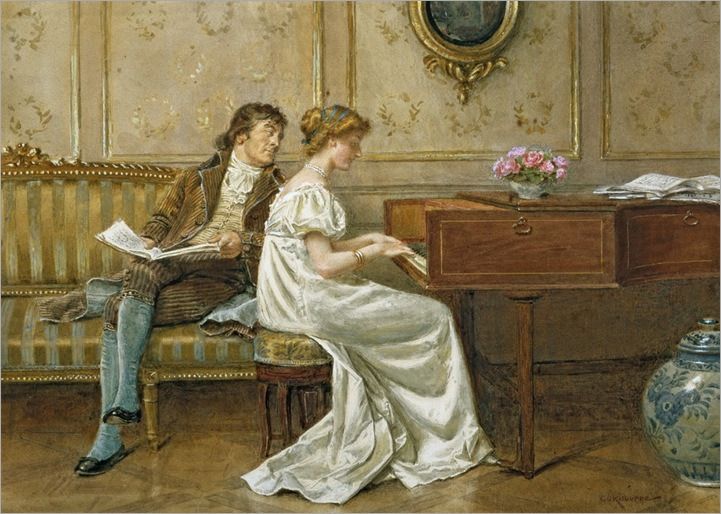
The featured image is “The New Spinet” by George C Kilburne.