The Curious Profession of Dr Craven. #Mondayblogs #free #romance

FREE TODAY (4/25/16) 0.99 the rest of the week.

For a taste, here’s chapter 1. Anyone know where I found the names Garth and Craven, and why I might have chosen them? (A prize for the first correct answer!)

The Resurrection Men.

The vicar intoned the familiar words from the Book of Common Prayer while the family mourned their loss. She died quickly, almost overnight, and now being placed in the family crypt.

FORASMUCH as it hath pleased Almighty God of his great mercy to take unto himself the soul of our dear sister here departed, we therefore commit her body to the ground; earth to earth, ashes to ashes, dust to dust; in sure and certain hope of the Resurrection to eternal life, through our Lord Jesus Christ; who shall change our vile body, that it may be like unto his glorious body, according to the mighty working, whereby he is able to subdue all things to himself.

That night, the four resurrection men met the verger in the dark churchyard. They carried shaded lanterns and intended to retrieve the ‘vile body’ before it became too vile for their client to use. They wore scarves over their faces to mask their identity. Grave robbing, while technically just a misdemeanour, was a serious offense so they made sure to leave nothing to chance. Still, the money they earned was good, and the likelihood that they would be caught was small.

Elias, the verger, pocketed the four crowns the oldest resurrection man had given him. Then he led them to the Patterson family crypt and put the key in the lock on the barred, iron gate and gave it a turn. He pushed on the gate, and as it creaked open, he turned and said to the resurrection men, “She was just put in here this morning. Should be fresh.”

“That’s what the doctor wants.”

“Take care, this hasn’t been a quiet one.”

“What do you mean?”

“I thought I’d heard noises.” They all listened and other than the distant “goo-de-who” of an owl it was quiet.

“Elias, you daft bugger. You’ll have us jumping out of our skins. Which one is it?”

Elias led them to the newest coffin. There hadn’t been time to etch a metal plaque for its occupant. A temporary paper label attached to the top said, Cecelia Jane Garth 1790-1810. Resting in Peace with the Lord.

He pointed, “That’s her. The poor lass, she was just engaged to a rich suitor. She faded so quickly, and even Sir William Knighton couldn’t save her. One day she was happy, and then she was gone.”

Then he anxiously looked at the four resurrection men, “Do I have to watch?”

“Nay, man. Not if you don’t want. Why don’t you keep an eye out for the curate?”

Elias stood at the door to the crypt and kept watch while the resurrection men pulled the coffin off its shelf and lowered it to the floor. They opened it and gazed at the contents.

“Aye, Dad,” the youngest said, “She was a beauty. Pity to anatomize her.”

“That’s how we stand the nonsense, Lad. Up with her, and careful. The doctor wants them unblemished.”

“She’s not stiff, and a touch warm.”

“Maybe she’s not as fresh as Elias said. Starting to rot mayhaps.” The senior resurrection man turned to the verger and said, “Elias, are you sure this is the one?”

Elias looked, “That’s her. Miss Cecelia Garth. God rest her soul.”

The four resurrection men stretched her body on the hard ground of the crypt. It was wrapped in a winding sheet for burial, with ties to bind her legs and arms together. A bandage around her head held her mouth shut. Then they put rocks in the casket, resealed it, and replaced it in the crypt. In the process, the paper label ended up on the inside of the casket.

Then they carried her out of the crypt and into the dark churchyard.

The gate creaked again as Elias shut it. There was a faint gasp at the same time as he turned the key in the lock.

“Did you hear that, Da?” the youngest resurrection man asked, shocked at the noise.

Elias said, “That’s what I mean. She hasn’t been a quiet corpse.”

Jonas, the eldest resurrection man, spat and then said, “What a lot of superstitious buggers you are. It’s just the wind.”

Together they carried the body to a waiting cart. It was tied to the kissing gate at the church, and the sorry looking excuse for a horse waited patiently to take up his labours. Since the body had been a beautiful young woman, they carefully laid it in the back. They pulled a blanket over it and then covered that with straw. It wasn’t often they encountered the watch, but it was just as well to be prepared. They hopped onto the cart, and Jonas held the horse. They clumped off into the night at the fastest pace the horse could manage.


****


Elias pulled the four crowns from his pocket and carefully examined them. The pound they summed to, equivalent to almost half a month’s work was a welcome addition to his meagre wages.

He said, “Just hope I don’t get caught,” to the wind that was whistling in from the dark of the night. He pulled the gate to the graveyard shut with a loud creak, then latched and locked it. The noise seemed to echo forever in the distance so he listened for the footsteps that would presage a hue and cry. All he heard was that bloody owl.


****


“Dad,” the youngest resurrection man said, “where are we bound?”

“We’ll drop these two lads off at the Red Lion. Then you and I shall take the young miss to her final destination.”

“Jonas, you said.”

“Now shut your gob. I’ll pay thee. No reason to risk us all getting run in by the watch. Now is there?”

“Reckon not. Still, we should be there when you meet the anatomist. How do we know you’re not trimming us over the price?”

“Listen Lads, the less you know, the safer you are and the safer he is. The safer we all are. I’m only taking my boy because I need his muscle. Gettin’ old. ‘Sides which, he’s family and we’ll both hang together, any road.”

“It’s not a hanging offense, is it?”

“No, but it’s a fine and prison if we’re caught.” While not technically a death sentence, a long stay in prison wasn’t exactly good for the health. Scanty, poor quality food and the lack of light or ventilation in a crowded building tended to eliminate prison overcrowding.

The wagon pulled up to the pub, and the two unnecessary resurrection men jumped down. Jonas passed them a crown each, “More for you tomorrow after I’ve been paid. Now keep your blubbers shut.”

An hour later, Jonas pulled the wagon up in front of the old tithing barn in Streatham and tied it to a hitching post. An ancient building left over from the dissolution of the Abbey under King Henry; the barn was a massive stone building with high narrow windows that discouraged the curious. The tall arched roof still kept the rain out, at least most of it. While it was far enough from the centre of the village to avoid prying eyes, it was also slowly falling into disrepair. Dr. Richard Craven used it for his private laboratory.

The massive door squeaked as he opened it and greeted them, “Jonas, what have you for me tonight?”

“Just what you wanted, a young woman, fresh.”

“Excellent. Now bring her inside.”

“You’ll be paying me now. Like we agreed?”

“Ten pounds. I have it here.” Dr. Craven pulled a note from his coat pocket.

“Ten, nay man, twenty.”

“Twenty? You said ten before.”

“Twenty or we take her straight back.” Twenty pounds was almost a year’s wages for a skilled labourer.

Dr. Craven was in no place to argue. He needed a woman to continue his studies, and there she was almost close enough to touch. She was just another cadaver, on her way to returning to the common clay.

“Twenty it is, you rogue.” He handed Jonas two banknotes.

Jonas nodded to his son, “Bring her lad.”

The boy uncovered their cargo and shouted, “she’s moved Da’. She’s moved.”

“Nonsense boy. Must have been shifted by the roads. Now stop yer yammering and bring her in.”

“Da’ alone, by myself?”

“She’s a light one. Not like some of them.”

Light or not, a body is hard to carry one handed. The boy staggered under the weight. He followed his father inside with the good doctor. Once there, he asked, “Dad, can you help?”

Together they laid her out on the cold stone floor.

Dr. Craven inspected the body, gave it a sniff, and then nodded. “She looks to be in good shape. Smells fresh. Did you want the winding cloths?”

“Of course, and it has been thirsty work. Bringing her here. Deuced thirsty.”

The doctor sighed, “I’ll get the brandy for you.”

Then he walked to the far end of the barn where he kept a small store of run French brandy. Jonas, a man with a nose for the spirits that was only matched by his capacity for imbibing them, followed him. The dark shadows hid the debris of the doctor’s studies, the prepared examples, the bottles of preserved organs, and the strange retorts of his research from their view. A chorus of squeaking rats from the cages at the far end of the building only added to the atmosphere. What little Jonas could see through the flickering candlelight was disturbing enough, even for a hardened resurrection man.

Jonas tugged on Dr. Craven’s sleeve, “You will take the brandy from the right cask, won’t you? Not one of these odd spirits and poisons?”

The doctor laughed, “Of course, I need a dram myself. It’s been a cold night.”

In the meantime, the boy undid the bandage that held the woman’s jaw shut tight. As he pulled it off her, her mouth opened and she gasped for air.

He ran to his father and the doctor, shouting, “I tell you, Doctor, she’s alive!”

Jonas and the doctor walked back to him, carrying a decanter of the brandy with them.

Dr. Craven said, “Can’t be, Lad. That must have been gas escaping from the body. They do that, you know, as they decompose.”

The elder resurrection man nodded, “I’ve seen it before, many times.”

“So have I Dad, but this wasn’t that. She gasped for breath when I undid the bandage.”

Dr. Craven said, “I’ll prove she’s dead. Put her on the table.”

The resurrection men lifted the body from the floor and put it on the examining table. It having once been a delicate young female, they were gentler with it than they were usually. The doctor gave his hands a quick rinse. Something he did more for superstition than any rational basis, and then he proceeded to examine the body.

“She is warmer than I’d expect. The decomposition must be advancing rapidly. I’ll need that ice.” He paused. It, no not it, she breathed. It was a gasp, a weak one at that, but a breath.

“Brandy!” He shouted, “and be quick about it, man. She’s alive.”

The youngest resurrection man ran for the decanter and returned as fast as he could. “Here, sir.”

The doctor took some and moistened the woman’s lips with it. She gasped again and stirred. “She’s cold, bring a blanket and a warm brick.” He immediately unwrapped the winding bandages from her body and untied the bindings on her legs and arms. “Come man, rub her legs. We must get the blood flowing.”

Between the warmth, the brandy, and the commotion, the woman’s eyes suddenly opened, and she sat up. She saw this handsome dark-haired man looking at her. His concern for her was evident in his face.

“Is this Heaven?”

“No. England.”

“Close enough.” Then she lay back and closed her eyes again.

The Witch #WriterWednesday

This is the start of a science fiction story I’m developing.

The Witch, a short story.

The good witch of the west arrived from the air in a bubble.

Farmer Giles was the first to see her. There was a clap of thunder, despite the clear blue sky, and when he looked up there she was. She rode down to him, dressed like a man but in shining silver, suspended under a silken bubble. She stumbled when she landed in the field next to him. He’d just finished plowing a quillet, and was turning his team for the next when it happened.

She removed the clear ball from her head, and put it on the ground next to her. The wind caught her silk and she was struggling with it, when she said to him, “I say, farmer. Can you help me with this?”

“I don’t speak French, can you speak English?”

She didn’t understand him either, so she tried again speaking one word at a time, “Can, you, help, me, please?”

He shook his head. It still didn’t make sense.

She managed to pull the silken bubble together into an awkward mess, and said, “First rule of survival is to never leave anything behind. You never know when you’ll need it.” She turned to the farmer again and tried once more, “Is there a village or town nearby?”

“Village, I know that word.” Farmer Giles said, then he pointed to the valley where a small cluster of thatched wattle and daub houses clustered around a stream. Smoke rose from the houses and filled the valley where it was trapped by a thermal inversion.

Understanding his gestures rather than his words, the witch bowed and said “Thank you.” After gathering her parachute into a rough bundle, she started to walk towards the village. It wasn’t easy for her to walk. The unwieldy parachute, awkward silver clothing and a decided limp from a twisted ankle, made her progress painful.

She hadn’t walked far, when the Lord of the manor’s youngest son rode up. He was followed by a squire. A handsome black-haired man, he was back from the university during the break between terms. Taking advantage of his time away from the drudgery of his studies and the ferocity of the professors, he was hunting with his falcon and saw the witch land.

He said, “Who are you?”

“What did you say?”

“Oh you speak the high language.”

“Your pronunciation is strange, but at least I understand you. Can you tell this idiot to help me?”

“Giles is not an idiot. He’s sound man, a leader in the village and in his tithing.”

“That may be, but I need help with my chute.”

“Fair Lady, you didn’t answer my question.”

The witch stared him in the face, something gentlewomen didn’t do as a rule, and said, “For that matter you haven’t told me yours.”

“I asked first, but I am Rupert. The youngest son of Lord Middleton. This is his demesne.”

She smiled and said, “Thank you, Rupert. I am Rebecca Sansome, a pilot and captain in the space corps.”

“The space corps? So the legends were real after all.”

A Formulaic Romance, Chapter 4. #amwriting #wip #romancenovel #mondayblogs

This chapter introduces two things in the context of a country ball. The chief villain (what’s a romance without a villain?) and the plot element that motivates the characters. The plot, like all romances, is girl meets boy, then after various complications and difficulties, they figuratively ride off into the sunset together.

The chemistry, by the way, is accurate. Fulminates were first described in 1803, you can download the paper from the Royal Society, and it makes for interesting, if slightly scary reading. Imagine describing the taste of a mercury salt. Especially one that explodes. Brave men in those days. Lucky too. I wouldn’t do it.

The featured image, a cartoon from 1815, shows the consternation American work along a similar line to Rupert’s produced in the English Navy. This was serious stuff.

It continues from the previous chapter, or you can start from the beginning.

My co-author Amelia and I often put the beginnings of books on my, now our, blog. They don’t always make it to the end, but it’s helpful for our writing. This is another Regency Romance. This time without grave robbing or financial dealing and legal chicanery.

A Ball, in the Country.

George surveyed his friend when Rupert emerged from his room. “I say Ga- Rupert, that suit, it’s as queer as Dick’s hatband, positively ramshackle. I’m sure your man did his best, but I say.”

“What?”

“Have to get you to the Village. That suit, it’s at least years out of date, a sartorial solecism.”

“What’s wrong with it?”

“Can’t you tell? I suppose it was your fathers.”

“No. Mine, from … back then.”

They were joined shortly by Rachel. There was a hidden advantage at having a small wardrobe. She was dressed in record time.

“Lord Hartshorne, Rupert, you need to take care of yourself. That suit, it practically hangs off you.”

Rupert paused, then said, “I do? … I suppose you’re right, I haven’t been eating.”

“Nor dancing?”

“No, not since.” Rupert stopped. A pained expression grew on his face.

“Antonia?”

“Yes, her. I last danced with her.”

Rachel broke out in a hearty laugh, “Then your next dance can be with me. If you don’t need the practice, I do.”

Rupert flashed Rachel a quick smile. “You’re right. I’m sorry, it’s an old habit and one I intend to break. Worrying about that virago. I’m well out of it.”

“Good. Especially if we’re engaged, even informally. I could still break it off and I will if you’re still holding a candle for her.”

“No. I’m not … please believe me.”

Rachel curtsied to him, “I’d be honoured to dance with you, even more than once.”

Rupert, having thoroughly considered Rachel’s words, said, “You are right. I have buried myself too long … Please dance with me.”

George chuckled at this, “Then I’d best ask now for the second dance, Lady Hayfield. Can’t let my nephew monopolise you.”

Rachel laughed “The honour’s all mine, My Lord … My Lords.”

Lucinda, hurrying in to accompany her charge, said, “What’s this about?”

“Just arranging my first two dances, Lucy.”

“Oh, good, Ma’am.”

George said, “Miss Holloway. Would the first dance be acceptable?”

“I couldn’t. My place … with the chaperones and the mothers.”

“Lucy,” Rachel said, “Of course you could. In fact I think you should.”

“As long as it isn’t a waltz.”

George said, “I would think it will be a country dance. Gas old boy, you wouldn’t know if the Waltz has penetrated these wilds?”

Rupert ignored him.

“Rupert, then. What about it?”

“No I wouldn’t, but I’d think not.” Then he smiled at Rachel and gave her a quick bow, “Though if it has, Lady Hayforth, I must claim your hand for it now.”

****

Rachel watched the country roll by as she rode in Lord Hartshorne’s carriage. The miserable country road she and Lucy struggled down. It seemed so long ago, although not even two weeks had elapsed, passed by in comfort. Her broken carriage sat where she’d left it. The carriage wright had removed the wheels and rear axle. Until those were repaired, the broken mainbrace and other things couldn’t be finished. What was taking so long? Then she realized that it didn’t matter. She had a carriage, and Rupert would take her to London.

She turned to Rupert and said, “This carriage, it’s so much more comfortable than mine ever was. Even before it broke. Almost luxurious.”

“It is?”

“Padded seats, and dry.”

“Lady Hayforth,” he nodded, “if that’s your idea of luxury, you’ll be soon satisfied.”

Lucy nudged her mistress and whispered, “I told you he was a good one.”

George asked, “What was that Miss Holloway?”

“Just congratulating my mistress on her engagement.”

****

The orchestra, a pair of violinists, a bass and clarinet, struck up the first dance. Fortuitously it was a familiar country dance in slow time because both Rupert and Rachel were out of practice. It also gave them time to converse, though most of the time Rupert smiled at his partner. Rachel thought It’s as if he can’t believe his good luck. When they finished, he said as he bowed, “Thank you. You must think I’m a poor conversationalist, but I was counting the figures. Wouldn’t do to disgrace you with an awkward partner.”

Rachel talked more during the next dance with George. He started, “I must admit you have made a difference in the poor lad. Good thing I suggested it.”

“You didn’t, you know. Just that I try to befriend him. Anyway he had guessed.”

“Observant little tyke, my nephew. Still.” The figures moved them apart. He continued when they came together again, “Still I am surprised that he proposed.”

“Or that I accepted?”

“That too.”

“To be honest, I refused at first. Hardly knowing him, but Miss Holloway pointed out the certain evils or my choice.”

“That you might not get another offer? He’s an odd one, Ma’am. Full of surprises. I didn’t know.” The figures intervened again, “I didn’t know about his work for the army. Old Gas making bangs.”

Eventually the chords drew to a close and it was time for supper. Disaster struck. A strange man interrupted Rachel and Rupert as they walked together to the table where the refreshments were served. He was dressed in plain and simple clothes, but was clearly important. Or, perhaps, it was clear that he thought he was important.

“Miss Heppleworth.” He bowed to her.

“Do I know you?”

“Surely you’ve not forgotten me so soon.”

Rachel studied him, “Mr Harding, out of fleet prison already; who paid your debts?”

“It’s Mr Oliver, Mr William Oliver. May I be introduced to your partner?”

Rupert’s face stiffened. “I believe we’ve met as well. How to you know my fiancée?”

Mr Harding or Oliver or indeed one of several other names chosen for convenience and anonymity bowed to him and said, “I knew her father, quite well. She was promised to me.”

“I wasn’t. Never.”

“Clearly your father didn’t tell you. It was made shortly before his unfortunate demise.”

“All I know is you helped him spend his money. Left us to rusticate on a mortgaged estate that could barely support itself.”

“I shan’t ask much for a settlement, breech of promise is such an ugly idea. Very destructive of one’s reputation, even if it is ultimately voided.”

Rupert glanced at Rachel. She was pale, barely fighting off a faint.  He turned to the man and uttered “You puppy!” from his clenched mouth. Then turning to Rachel he said, “Rachel, let me help you to a seat.”

As they walked to the far side of the room, neither of them noticed the grim smile of satisfaction that coursed over Mr Oliver’s face. After he’d helped her to a seat, Rachel looked up and said, “Did you say you knew him, how?”

“That cad, that puppy, he carried the letters between Antonia and Lord Biddle.”

“Oh Lud! What a mull I’ve made.” Rachel put her face in her hands. “I wish that … that … that fellow were at Jericho.”

“What do you mean ‘I’ve made’? I fail to see that you’ve done anything.”

Rachel bit her lip and looked up at Rupert, tears forming in her eyes. “I didn’t know about him … him and that awful woman.”

“How could you know?”

“I suppose you’re right, I couldn’t have. Please believe me that I have no interest in seeing Mr Harding or Oliver or whatever he calls himself now ever again. His effrontery.”

Rupert shook his head sadly, “I know.”

“He really did lead my father to perdition with the dice box, faro table, and … I don’t know what all they did. My father caught an ague from some.” She stopped, unwilling to voice ‘barque of frailty.’ “That man played him for a jobberknowl until he was skint.”

“Don’t let that dandiprat cut up your peace.” Rupert paused, “Unless there is something you’re not telling me.”

“No. Well maybe. He did have some of my father’s vowels. They should have been settled with the estate. There could be something like those. Who knows what my father may have signed before he died. It was a desperate time, and he wasn’t truly in his right mind.”

The musicians chose this auspicious moment to start tuning their instruments for the next dance. Rupert bent down and took Rachel’s hand. “This dance is ours.”

“But?”

“We’ll talk later, I’ve had my dealings with that puppy, too. Not just with that woman.” Rupert led her to the middle of the floor where they started the line for the next dance. It felt to Rachel as if everyone in the room were staring at them. Sir John certainly was. Rupert bowed to him and said, “I should like to lead this dance, with my newly affianced wife.”

“Oh,” He laughed, “I guess you meant what you said.” Then he tapped on a glass and shouted to get attention. “Dear guests, before we begin, a toast – to our neighbour Lord Hartshorne and his intended. Newly engaged. May their marriage be long, and happy.”

Rachel thought, If it isn’t happy, it will certainly be long, then she shook her head and studied Rupert. It will be happy. I will make certain of that.

Mr Oliver started to object, when he felt a firm hand on his shoulder. It was George. “You, sir, are coming with me. This is the last time you will bother Lady Hayforth. Do I make myself clear?”

The dance started with both Rachel and Rupert lost in each other, both too overcome with emotions to say much.

Part way through the dance, George re-entered the room, dusting his hands. He strode to his host, Sir John and said, “That’s done. What ever possessed you to invite such a rotter?”

“He’s the man of the moment. Helped break those revolutionaries in Pentridge, at great personal risk.”

“Knowing him, I doubt it.”

“I must remind you I’m the host, and General Byng will be most displeased when he hears of how you’ve treated his best agent. A real British hero.”

George indicated his lack of concern when he said, “If you say so. I don’t know the general well, but I’m good friends with his cousin Poodle. I think I can weather the storm.”

****

Once the ball was finally over, in the carriage home, Rachel asked, “What happened to that man?”

“Mr Oliver?” George said, “I suggested that he make an early night of it.” He smiled, “rather forcefully I might add.”

“And Rupert, my love, you said you’d known him.”

Rupert hesitated, then said, “Yes … he offered me money … to see, make a copy of what I was doing for the army. I think it was when I refused that he introduced An- that woman to Lord Biddle.”

“What were you doing, Gas … Rupert that would be worth money?”

“I guess what I did is not really secret, the secret details aren’t interesting anyway. You’ve shot with one of those scent-bottle locks George.” Rupert stretched back in his seat, ready to be expansive.

“Dashed good gun. Yes. Faster and more reliable than my Manton.”

“The Army thought so too. Started working on them in the Tower Armoury. They came within aces’ aim of levelling the place with all the fulminate they made. Guy Fawkes would have been delighted. His Majesty less so.”

Rachel and George leaned forward to hear every word. George said, “I see. So…”

“So I worked on more stable fulminating mixtures. Oxymuriate of potash, various … fillers to make it more stable. I was, ah, more than moderately successful. Had the war dragged on, it would have made a big difference. General Shrapnel’s shells with my fuses, mayhaps on rockets. Torpedoes that exploded on contact. Can’t say too much more. It would have been ‘interesting’ to say the least.”

Rachel gasped, “So he was a French agent?”

“Maybe. More likely working for the highest bidder – French, American, those damned Prussians or even the Tsar.”

“Good Lord Nephew. I never knew. Just thought you were playing around.”

Rupert laughed, “I’m not saying it wasn’t fun, but I’m glad to work on safer things.”

Lucy, who had been quiet because she was tired and had consumed more than her share of the punch, said, “I bet Lady Hayforth is too.”

A Formulaic Romance, Chapter 3. #amwriting #wip #romancenovel

Things get more serious in this sweet romance. Lord Hartshorne isn’t as clueless about his Uncle’s machinations as he seems. He decides that this young woman will do. She’s not as dashing as his lost Antonia, but presentable, friendly, and more importantly not likely to hurt him. Life together won’t be passionate, but it will be comfortable and companionable.

It continues from the previous chapter, or you can start from the beginning.

My co-author Amelia and I often put the beginnings of books on my, now our, blog. They don’t always make it to the end, but it’s helpful for our writing. This is another Regency Romance. This time without grave robbing or financial dealing and legal chicanery.

A Serious Chapter.

Next morning, the rain, having finally, finally broken, George, with the time hanging heavy on his hands, found Rachel and Lucinda at breakfast and said, “I feel like a ride. Do you ride Miss?”

“I used to.” She grimaced, “Sold my hunter to pay for this trip so in a sense I’m wearing her.”

“That’s too bad. Rupert used to keep a good stable. He’s let it go in the last years, but I’m sure there’s something worth throwing a leg over. Would you be willing to accompany me on the downs?”

Lucinda gushed, “Yes. I like to ride as well.”

George bowed to the inevitable chaperone, and realizing that Lucinda was better company than most chaperones, rose and bowed. “I’ll inquire about the horses and see if there are side-saddles.”

After he left, Lucinda turned to Rachel and said, “What an elegant man.”

“Yes, A pity he’s engaged … to a Miss Deacon, his ‘Charity.’ The good ones all get taken. I think we’d best hurry to London before they’re all gone.”

“Don’t be so cynical. There’s always, what was it Lord Beddlington called him? Gas.”

“He’s handsome enough, I’ll grant you, but so dashed odd. Buried in that workshop of his.”

“You can change that, can’t you? Or at least take an interest in his work.”

“I suppose.” Rachel studied the room, found it lacking inspiration, and finally said, “I suppose I could change my name to Sodium, Natria or something elemental. Then he’d like me.”

George overheard that as he entered the room, “I wouldn’t, Ma’am. Rachel is a pleasant, if unusual name.”

“My father found it in the Old Testament. Could have been worse, Delilah or Jael. What did you find about the horses?”

“I found Brindle and he sent a footman. Unfortunately, he remembers only one serviceable side-saddle. If that.”

Lucinda’s face fell. “So a groom will accompany you.”

“Unfortunately, yes.” George bowed gently again, “I should much rather have both your company.” As he straightened he smiled at Rachel, “Lady Hayforth, I await your pleasure.”

****

Upstairs, in her room, Lucinda pulled Rachel’s riding habit from her trunk and brushed it down. She said, “Sad, isn’t it, that you haven’t had many chances to wear it? Since selling your mare.”

“I don’t know, Lucy. You enjoy riding much more than me. Why don’t you wear it and ride with Lord Beddlington?”

“I couldn’t.”

“Well, I shouldn’t.”

“What do you mean by that?”

“I’ve seen it in his eyes and … his smile. He likes me, and quite frankly, I like him. But he’s engaged, off the market. It would never do to become more than just friends with him.”

“Oh, and you think I’m safe, that he won’t look at me, that I’m too plain?”

Rachel laughed, “I didn’t mean it that way, but you are safer. Besides, he asked me to tempt Lord Hartshorne into going to London, and I’d best be about my business.”

Lucinda hesitated, so Rachel continued, “You’re doing me a great favour, and in any case I’ll have a chance to parade in Hyde Park on one of Lord Bromley’s nags whenever I’d like. You won’t.”

Lucinda allowed herself to be swayed. When the two women returned to the parlour, George stared at them.

“I thought, Lady Hayforth that you and I would ride.”

“Miss Holloway is the better rider.”

“Am not.” Lucinda added in a whisper.

“Is the better rider, and I’d best be about completing that task you set me. I won’t succeed if I don’t pay attention to his Lordship.”

George nodded, “Yes, there is that … Miss Holloway, pleased that you will ride with me.”

Lucinda said, “I hope that you’re not too disappointed.”

“No, not at all.” Rachel caught the hint of disappointment in his voice. It’s for the best.

****

Left to her own devices after they left, Rachel found her way to the front parlour. A spinet, dusty and disused, but surprisingly still close to in tune sat in a corner. She started playing, first from memory, and then from a piece of sheet music.

Lord Hartshorne startled her and she stopped playing, “Lady Hayforth?”

“Yes?”

“I … should like to … apologize. Last night.”

“For what?”

“I had intended to return, to keep you … and George company. It’s just … Well, I became distracted in my notes.”

“That’s what I thought. Do you mind if I keep playing?”

“No. Please do … You play very well.”

Rachel resumed playing, but continued to talk. “I thought you would be in your laboratory today.”

“Usually, but not today. Not when I have.” He paused for more than a moment, “To be honest, I caught a few too many breaths of the fumes, and need to let my lungs clear.”

“I thought you were going to say, ‘not when I have company.’”

“That too. It’s just.” Rupert couldn’t overcome his shyness.

“It’s not Antonia, is it?”

“How do you know about her?”

“Your uncle.”

“George needs to keep his mouth shut. Yes it is. Your playing, it reminds me of her.”

“Should I stop?”

Rupert stared out the window. The grey skies from the last few day’s rains were gone. He could hear the birds and imagine the fresh smell of the drying earth outside. He turned back and said, “No. I liked, I like music.”

Rachel stopped for a moment, nonetheless. “Do you play?”

“A little, I haven’t in years. Not since …”

“This is a duet. The bass part is simple. Would you-?” She blushed. It was putting herself forward.

“Join you?” Rupert studied the window again, then flexed his fingers. “I’ll try. It’s been a long time since I’ve played.”

Rachel scooted to the side of the bench to make room for him. When he sat next to her she thought, He’s so thin, needs to look after himself … needs someone to look after him.

Then they played together. It wasn’t exactly the best performance, and certainly no one would have thought either of them an adept, but it didn’t matter. They were lost in the music. Together.

Eventually the piece came to an end. Rupert said, “I haven’t sat this close … I mean played a duet with … not since Antonia.”

“I’m not her.”

“I know.” Rupert sat quietly. Rachel could see the confusion in his face.

“Tell me about her, if it would help.”

“Not much to say. A beauty. I thought, no I was in love with her. I thought she was in love with me. We were …”

“Engaged?”

Rupert nodded, “Then she eloped with Lord Biddle. Didn’t even leave me a note.”

Almost unconsciously, Rachel reached for his hand and squeezed it. “It must have hurt.”

“It did.” Rupert turned to face her. After studying her face for what seemed a very long minute he said, “But that’s over.”

“Good.” Rachel suddenly felt a little breathless. She sat too close, too alone, to a man. Not only that, she held his hand. Without gloves. The bleached streaks and white pallor of his skin accentuated the darkness of his eyes. She sat too close to a far too handsome man for comfort.

Rupert only made it worse. “Marry me.”

“What?”

“Marry me.”

“Lord Hartshorne,” Rachel rapidly backed away and tried to stand. Only to trip on her gown and land on the floor.

Rupert calmly moved over and helped her up. “I’m sure George has, by now, asked you to help shift me to London.”

“How’d?”

“I know my Uncle. For that matter, I could tell something was up, from Mrs Hobbes. The way she smirked this morning. What did he offer you?”

“To help pay for my season.”

“I see. A bit mercenary?”

Rachel laughed, “No, a bit desperate. Lord Hartshorne,”

“Rupert.”

“Rupert, then. I hardly know you, and you hardly know me. How could we possibly wed?”

“I like the way you play your instrument, and you’re beautiful. You handled my … impoliteness with grace.”

“That’s not enough and you know it. Or you’d know it if you thought it through.”

“I thought it through with Antonia. Should have just kept looking.”

Rachel saw a flash of distress on his face.  He still is in love with her. “Are, are you sure? I, I can’t.”

“It won’t be passion, I’m done with passion, but I can offer you comfort, comfort and security … I think we should get on well enough. Learn to love each other in time. So what about it?”

“I can’t say yes. You know that.”

Rupert’s face fell.

“But I won’t say no. How would ‘maybe’ work for you? You’re not unattractive.”

“That’s damning.”

“Alright, you’re handsome, and you don’t seem vicious. I’m willing to see if it works. Will that do?”

“Maybe.”

“It’s better than no.”

Rupert chuckled. “You’re right. Maybe will be first rate.”

“And you’ll come to London with me?”

“I’ll bring you to London. If only to show George that he shouldn’t trifle with the head of the family.” Rupert’s smile broke into laughter.

“What’s so funny?”

“I’m just imagining the expression on my step-grandmother’s face when I turn up with a dashed good-looking armful.”

Rachel’s attempt to question Rupert about why that should matter was interrupted. Lucy stood in the door and shouted, “Miss Rachel, what are you doing? Alone with a man.”

“It’s fine Lucy. Lord Hartshorne has been a perfect gentleman. We were-”

“That is as may be. But you shouldn’t be alone with him.”

Rupert rose, bowed and said, “Miss Holloway, how was your ride?”

“It was exquisite. Now Miss Rachel, come with me. We will have a conversation, about your deportment.”

Rachel gave Rupert a wan smile, “See how I’m managed.”

“It’s for your own good, Ma’am.”

Upstairs, in Rachel’s room, as she helped Lucy out of her riding habit, she asked, “How did it go, really?”

“It was fine. The mare was a little barn-soured, but nothing I couldn’t handle. Lord Beddlington was nothing if not a gentleman.”

“Exactly what I’d expect of him.”

“It is. What, may I ask, were you and Lord Hartshorne doing?”

“Playing the spinet. I found a duet. We played it together.”

Lucy chuckled, “Since you haven’t practiced, in … I don’t know, ever so long. I’m glad I was out riding.” She noted that Rachel was unusually distracted, thoughtful. “Did something else happen?”

“He, he asked me to marry him.”

“I hope you accepted, much nicer to be engaged. It’ll solve no end of problems.”

“I didn’t.”

“You didn’t refuse him!”

“I didn’t. I said maybe.”

“Whatever possessed you? You know your situation, and … Good Lord Rachel. Get yourself back down there and tell him you accept his hand.”

“But?”

“But nothing young miss. He’ll make you happy. Happy enough.”

Rachel sighed, “I suppose you’re right.”

“I am. You know I am. With the war there aren’t enough able and eligible men left, and things are so tight with so many soldiers returning from France. We saw a mob.”

“You did?”

“I’ll tell you after you’ve talked to Lord Hartshorne. Lord Beddlington and the groom went to find the local magistrate.”

“Can you come with me?”

“Support you in your time of crisis? If you insist.”

Accompanied by her companion, Rachel returned to the study. Then she rang the bell for the servants. When Mr Brindle appeared, she asked him if he’d seen Lord Hartshorne.

“I believe, Ma’am, that he was headed to his workshop.’ Mr Brindle’s well-trained impassivity concealed his intense curiosity. “I could, if you desire, show you the way.”

“Please.”

Rupert was in his laboratory, with the window open, while he worked through his notes. Rachel’s nose puckered at the remaining smell, the peculiar tang of chemistry. “Lord Hartshorne, Rupert,” She curtsied, “About what you asked me.”

“Yes?”

“I had the time to think, to gather my thoughts. I shouldn’t have said maybe.”

Rupert’s face tightened with worry, then relaxed when he saw she was smiling at him.

“I should have said yes.”

“Do you mean that?”

“That I should like to marry you? Yes. Why would you think otherwise?” Sensing his disbelief, she continued, “I should think there’d be a queue. You’ve such a lost, helpless, romantic look. Childe Harolde or Florian personified. Besides, you told me you were done with mourning that woman.”

Rupert flashed Rachel a quick smile. “You’re right. I am done with her. And you’ve made me the happiest man.”

“Good. Especially if we’re engaged, even informally. I could still break it off and I will if you’re still holding a candle for her.”

Rupert shook his head, “Antonia is at most a bad dream, one … I think you’ve helped me wake up from it, my love.” He paused for a few moments thought. “We’ll need to attend to the settlements, my solicitor is in London.”

“Good thing we’re going there anyway. I’d like the chance to dance with you. To have a season. I’ll write to my cousin Lord Bromley … he was my guardian and will know what should be done.”

“You can do that while I finish my notes. I still intend to present my work at the Royal Academy. Then I’d love to show you the downs. My farm.”

“A walk?”

Rupert nodded, and then glancing at Miss Holloway, added, “If your companion approves.”

Lucy replied, “I should love to accompany you, as long as it’s not too muddy.”

****

When George arrived back at the Hall, he found Rupert, uncharacteristically, enjoying a nuncheon with Rachel and Lucinda. Even more uncharacteristically, he was smiling.

“What did I miss, Gas?”

“Rachel has made me happy.”

George frowning, glanced at her and said, “That was fast work my lady.”

She replied, “It was Rupert who asked me. He’s the fast worker.”

“I see.”

“We played a duet on the spinet.”

“And on that basis he asked you to marry him?”

“Yes. Is there a problem?”

“I’ll talk to you later.”

Rupert added, “We were wondering if a double wedding were in order, Uncle. Do you think Miss Deacon would mind?”

“I think she’d be delighted … At least I’d hope she would. Have you written Lady Beddlington yet?”

“No, which reminds me. There was other thing I wanted to discuss. When should we put the formal announcement in the Gazette? Rachel thinks not until the settlements’ been negotiated. What did you do with Miss Deacon?”

After giving Rachel a hard stare, George said, “I’d keep it quiet – for the moment.”

Rupert said, “You haven’t answered my question.”

“I will post my announcement when I return to London. It was only polite to ask the head of my family first.”

After they’d finished eating, Lucy chaperoned Rupert and Rachel as he showed her the downs. George insisted on tailing along with them. As Lucy and Rupert walked ahead, he dropped back with Rachel.

“Do you know what you’re doing?”

“I like Lord Hartshorne, very much, if that’s what you mean.”

George stopped, then surveyed the field of still-green corn beside the path. The heads were starting to fill out and the wind made waves as it blew along the down.

Rachel continued, “I’m sure I’ll grow to love him and he to love me. We’ll suit, both practical rather than passionate.”

“That’s not what I mean. Oh damn.”

“You’re engaged too. What would Miss Deacon think?”

“I mean, you’re too good for him.”

Rachel looked away and grimaced, “I doubt that. You don’t know me very well then.”

“You’re right. I don’t know you well enough.”

“Besides,” she laughed, “he’s the best available. My cousin, Lord Bromley, wasn’t enthusiastic about my chances at the marriage mart in London. If your nephew likes me enough to make me comfortable, then who am I to argue?”

George shook his head, “Yes. I’m sorry. Viewed in a practical light you acted with sense. I wish you well. At least you won’t run off like Antonia Green. That really did hurt him.”

“I can safely promise you that won’t happen. Lord Beddlington –“

“George.”

“George, I’m conformable. I’m sure I’ll be happy with Rupert and do my best to make him happy. What more can one hope in marriage?”

“Not much more. I hope it isn’t marry in haste and repent at leisure.”

“It won’t be.”

George looked up the path, “They’re getting ahead of us.”

“So?”

Lord Hartshorne and Miss Holloway waited at the top of the hill. Rupert pointed at a smudge in the distance. “General Byng’s camp. The town of Pontefract beyond.”

Lucy squinted, too vain to wear the spectacles she required to see clearly, and said “It is?”

When they caught up with them, George drew a deep breath and said, “I forget Gas … sorry, Rupert, how much I enjoy the freshness out here. Even with the occasional whiff of cow, it’s far better than London. Clean air, nothing like it.”

“Rupert,” Rachel asked, “You were showing something to Lucy. What was it?”

“General Byng’s camp. The 15th Hussars. What with all the troubles, I’m glad they’re nearby.”

“Troubles?”

“That meeting in Nottingham several weeks ago, and the march on Butterly. A bad business.”

“Not that they don’t have a point. The corn laws.”

“I know. It’s just we’ve fought to put down those nasty Frogs and now … ”

“We’ve fought?” George said. “I didn’t know you had a commission.”

“I didn’t, but I did work on things. Things for the army, the navy.”

Rachel asked, “What kinds of things?”

Rupert smiled, then held up his hands, spreading them. “Can’t say too much more. Still have ten fingers. I was luckier than most.”

A horseman rode up to them and haled them with a voice practiced from years of running to hounds. The squire and local magistrate of the parish, Sir John Tennant called. “My Lord, I haven’t seen you out this year. Never with such fair company.”

Rupert bowed his head gently, acknowledging Sir John with what he felt to be the proper amount of condescension.  “Sir John, may I introduce my Uncle, Lord Beddlington, Lady Hayforth and her companion Miss Holloway?”

“Delighted to meet you. Chasing the young ladies again, at last?”

“More than just a chase, Sir John. Lady Hayforth has agreed to be my wife.”

“Good lord, I didn’t think you had it in you … I say, I didn’t send you an invitation since I knew you’d refuse, but this changes everything. I mean if you’re entertaining company again.”

“An invitation?”

“A ball, informal of course, at the manor. Tomorrow night. There’ll be officers from the 15th, maybe even General Byng himself.”

“I think,” Rupert said, “I don’t know. Lady Hayforth what do you think?”

“I think I’d like to dance with you.”

“Then it’s settled. Tomorrow at the manor. Thank you.”

Sir John tipped his hat and cantered off.

****

That evening, after supper, Rupert joined the others in the parlour. After whispering something sweet to Rachel, which made her blush, he said, “George, old boy, what are you reading?”

George looked up from the sheath of papers he studied, “A letter … from Miss Deacon, Charity. I picked it up when I rode into town.”

Rachel couldn’t help but ask, “How is she? It’s obvious she likes to write. How many sixpences did that cost or did she get it franked?”

“Enough.” He laughed, “I’d say she crowned me with this letter. Half-crowned me at least. She took me to task for not writing recently, but this is mostly about the book she wants me to read. Improve my mind.”

“Which book?”

“The critic of pure reason, by Kant.”

“I’ve not read it. Is it interesting?” Rachel said.

“Wouldn’t know. Trouble is, I left my copy at home. Only expected to be away a day or so … What am I going to do? She’s expecting cogent answers by return post.”

“Oh dear.”

Rupert cleared his voice and said, “It’s a dense tome but he builds a strong argument for the existence of a common human mentality that foreshadows or shapes our understanding of the world. Indeed, he argues that without a preformed model of our experiences learning would be, itself, impossible.”

Everyone was silent until Lucinda said, “Was that German? Could you try it in English?”

“There must be a pre-existing mental structure in our brains that interprets our senses. In order to communicate, we must share a similar ideal or vorbestehenden modell of the world.”

“Oh. Interesting.”

“It is. You need a copy of his work George?”

“Do you have one?” George relaxed, “You’ll save my life if you do. Charity can be cutting when she’s upset.”

“Well thumbed. A fascinating work.” Rupert rang and when Mr Brindle appeared he said, “Can you get my copy of Kant’s Critique from the library.”

“Certainly sir.” A minute later he returned with a thick book. “Here it is.”

“Thank you. It’s for George.”

Rachel laughed when she saw the book, “A little light reading, Lord Beddlington?”

“The light of my life wishes I’d improve my mind, bring it up to her level, or at least closer to it.”

“I see, Sir.” Mr Brindle’s voice was dry, expressing his concern in the only way open to a servant.

George took the book from him and tried to read it, starting from the beginning of the eight-hundred pages of dense convoluted German.

“I say Gas,” he blurted, “This is in German.”

“Don’t you know German? It’s a language of great expressiveness.”

“Ein glass bier, bitte. Not much more than that. Enough to entertain the Prussian officers when they visit London. You don’t have an English translation?”

“No, and in any case it would be even longer. English isn’t as expressive as German.”

Rachel saw the distress on George’s face. “Lord Beddlington.”

“Please call me George. We’re all friends here.”

“Lord Beddlington, surely you can explain the circumstances to Miss Deacon. It wasn’t your fault that you were detained longer than expected.”

“I can try. Charity has fixed ideas about things, and philosophy is one of them. Bright woman you know. More educated and witty than I am.”

“I can’t imagine that she would hold it against you, especially if you showed up with flowers or some small gift.”

Rupert chuckled, “Was that a pun Rachel?”

“A pun?”

“I can’t.” Seeing that she didn’t understand him, he continued, “Immanuel Kant, I. Kant.” Overcome with his own wittiness he laughed.

Lucinda and Rachel eventually joined in.

George groaned, “What am I going to do?”

“Tell you what, Uncle. Read her questions to me and I’ll help you with the answers.”

“Like back in school?”

“Precisely, and I only ask one thing in return.”

“Anything Gas.”

“Please stop using that nickname.”

“As you say, Gas …

 
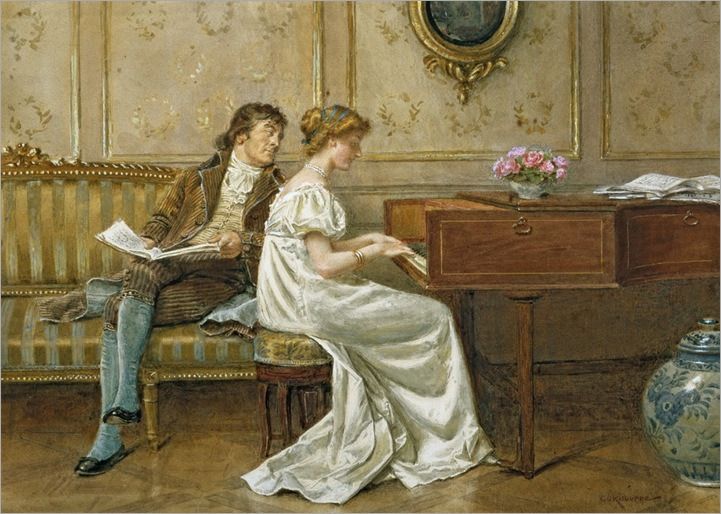
The featured image is “The New Spinet” by George C Kilburne.

A Formulaic Romance 2 #amwriting #Fridayreads #wip

Another gosh darned book, Second Chapter

I often put the beginnings of books on my blog. They don’t always make it to the end, but I find it helpful. This is another Regency Romance. This time without grave robbing or financial dealing and legal chicanery.

This is the second chapter. Rachel, Lady Hayforth had an accident in the first. It stranded her, for the moment, deep in the country and in the company of an odd, somewhat unsociable, young man.

I’d love to hear what you think. The title is an allusion to the hero’s interests. There’s another one in the story, but you’ll have to know your chemical history to get it.


An Unexpected Visitor and a Proposition.

In keeping with the country hours she was accustomed to, Lady Hayforth rose early in the morning, and after Lucinda’s ministrations searched for breakfast or at least a nuncheon to tide her over until the mid-day. Eventually she found a parlour, where Lord Hartshorne was restoring his tissues in preparation for a day in his laboratory.
He rose and bowed politely when she entered, “Lady Hayforth, did you sleep well?”
“Exceedingly. Thank you for your hospitality. I don’t know what we would have done had you turned us away. The weather still hasn’t let up.”
“It is wet.”
“Very.”
“Indeed, wet.” Rupert looked away. There seemed little more for him to say. He started to leave.
“That won’t cause you any problems, in your laboratory, will it?”
His workshop, safer ground for a conversation, he replied, “It shouldn’t, but I shall have to be careful. Avoid stray drops of water.”
“Really, why?”
“I told you I was extracting metals from salts last night.”
“You said something like that, although I didn’t understand what you meant.”
“Would you like to understand?”
Rachel studied his expression, it was like a new puppy, all excited and desiring to please. It made him almost look handsome. “If you could, but I am sadly ignorant about natural philosophy. It’s not something my parents … approved of. At least not my learning it.”
“That’s awful. At least did they let you learn the classics?”
“No, enough reading for Fordyce’s sermons and the arithmetic to see how much my servants were cheating me. They didn’t want to tax my constitution with too much mental work, not even reading novels. You know how it is with females.”
“I don’t. My mother was my father’s most enthusiastic assistant, or maybe he was hers. They published papers in the Royal Society together. Though she used a pen-name.”
“So you approve of educated ladies?” This was a novel idea.
“Very much so. I must attend to my experiments, but tonight, if you’re still here I can tell you about them.”
“I’ll look forward to it. If our carriage isn’t repaired. If it is, will you be in London this season?”
“I have a presentation to make, so I shall. The Royal Academy meeting.” He paused, then strode to a cabinet and pulled out a small jar full of oil and what appeared to be a hard cheesy substance within it. “Let me whet your appetite with a demonstration. If you’d pour some water in that bowl.”
Rachel poured a small amount of water in a delicate china saucer. Then Rupert used a knife and a spoon to remove a small amount of the ‘cheese.’ “This is sodium metal. I made it last month. The oil … Well you’ll see why I keep it under that in a moment.”
He put the lump into the bowl. It sputtered for an instant, then burst into flame. After the metal finished burning, the small amount of oil that adhered to the metal burned as it floated on the surface of the water and then went out.
“Natty isn’t it? Have to keep it dry or it burns.”
Rupert’s enthusiasm was catching, or at least Rachel caught it. Not unlike the sodium her face lit up, although in fairness she didn’t have an orange glow. “That is. I suppose you couldn’t do it again?”
“Let me dry the spoon first.”
Rupert was about to lower the next lump into the water when one of his footmen interrupted him. “Sir?”
“What is it this time?”
“A gentleman has come to see you, your Uncle Beddlington.”
“Tell him to hurry in. He won’t want to miss the spectacle.” He nodded to Rachel, “I hope you don’t mind the delay.”
A minute later a neatly dressed young man joined them. “Gas old man! More of your black arts?”
Rupert laughed, “Just entertaining my house guest, Lady Hayforth, with a little chemical demonstration. A foretaste of my talk in London.” He dropped the metal into the water. Whether it was a larger lump of sodium, or more pure than the last sample, this time, for some reason, the reaction was more vigorous and with a crack the saucer shattered.
The man said, after he’d restored his calm, “Wasting your inheritance again, Rupert?”
“Just a saucer, Uncle.”
“Uncle?” Rachel was surprised, “You look younger than Lord Hartshorne.”
“Old Gas? I am. His grandfather married again in his dotage, hence yours truly. Caused no end of bad feelings between my father and his. Not to mention his step-grandmother.”
Rupert frowned at his uncle. “George, what brings you here?”
“Not much. I was on the road and thought I’d drop in. This woman, dashed unusual of you.”
“Oh, Lady Hayforth, May I introduce my Uncle George, Lord Beddlington?”
She curtsied, “Enchanted.”
“I say,” George said, “That carriage on the main road. Not yours by chance?”
“It is. Broke down, but fortunately your nephew,” she paused at the thought of might have happened, “took my companion and me in. He even paid the carriage-wright to hurry our repairs.”
“Did he?” George surveyed his nephew. “Interesting. Gas old boy, don’t you like the company? Dashed handsome one, you know.”
Rupert gave him a hard stare, “I have my experiments. Lady Hayforth, George, I shall see you later.”
Mrs Hobbes knocked at the door, which delayed his departure. “Lady Hayforth? Miss Holloway has been airing the contents of your chest. The rain and muck entered them and she desires your guidance. If you’d follow me.”
Rachel sighed, then curtsied, “I must make my excuses. Undoubtedly I’ll see you later today?”
George bowed, “It will be my pleasure.” Then he watched his nephew, and reminded him, “Take your leave, Gas, like a polite gentleman.”
Rupert bowed to Rachel while she smiled at him in her curtsey. “I should like to hear more about your research tonight, if I may?”
He nodded, reluctantly, “I suppose. Don’t know that you’ll understand it.”
“Then you’ll just have to explain it carefully.”
Rachel turned and followed Mrs Hobbes. As she followed her down the corridor, Rachel asked, “How bad is the reckoning?”
“It is more a question of what can be saved. The chest cracked when it was dropped in the road. We’re hanging what we can on the clothes horse in the kitchen.”
“Dash it. I need that, for the trip to London. I barely have enough of the ready at it is, and that’s with staying at my cousin, Lord Bromly’s town-house.”
“Lady Hayforth, if it’s not an impertinence, may I ask you why you are in such a hurry to visit London?”
Rachel stopped midstride, and carefully formed her response. “I have the use of my father’s estate, or maybe the curse of it, until I’m twenty-four. Next year. Then I’m cast adrift. So …”
“You’re trying your hand at the marriage market?”
“It’s either that or the flesh trade, a governess or companion. I don’t want that and what would happen to Lu- Miss Halloway, my best friend.”
Mrs Hobbes nodded, and said nothing, but stored the information to discuss with Mr Brindle that evening. After a few moments she said, “Let’s see what can be done with your gowns, Ma’am. I should think all is not lost. If you don’t mind, we’ve hung them on the clothes horse in the kitchen.”

****

Meanwhile, George accompanied his nephew to the laboratory.
“You’ll have to leave once I start the process,” Rupert said, “but you can wait while the salt comes up to heat.” He stirred a coal fire into life below a crucible, then bent over and blew into it. “It will take a few minutes, and I presume your visit isn’t simply a social call.”
“It is, and it isn’t. You can be the first to give me felicitations.”
“Or as head of the family I could forbid it. Melody, I presume?”
“Charity, Melody was last year and I’m sorry to say we didn’t click. Lord Broughton’s new wife, now. I suppose I should have said ‘glad to say we didn’t click.’ Charity’s much nicer than Lady Broughton.”
“I suppose I can approve. You’re not expecting me to attend the wedding?”
“Ah, well … it would be generous. Indeed, somewhat expected of you. Show good form and what not. And Mother sends her greetings. Wishes you all the luck at continuing your experiments.”
“You know, when she visited here last year, she spent her time measuring for curtains and counting the spoons.”
“It’s your own fault, Gas. If you’d make a push and break the entailment, it would be a big weight off my shoulders. As much as I love her, my dear Mater can be trying at times.”
Rupert didn’t reply so George continued, “You’re not still pinning for what’s her name?”
“Antonia? … No, not really. But I swore not to let myself be hurt like that again. I’m done with females.”
“I see, and this pleasant young chit, you have staying here?”
“Her carriage broke down last night. I couldn’t turn her away, could I?”
“I suppose not, but you seemed to enjoy her company this morning. What was that stuff you put in the saucer?”
“Sodium … Don’t read more into it than you have. I’ve offered the carriage-wright a hundred pounds to finish repairs today. She’ll soon be off to London or whatever. Good riddance.”
“I see.”
“What are you hinting at? That I ought to marry her just to cut you out of the inheritance? She’s a pretty enough chit, I’ll warrant you, but ignorant and untutored. Not only that but …” Rupert couldn’t finish his sentence.
“But what? Besides if it’s just ignorance, you can fix it. She’s not dull, is she?”
“I wouldn’t know … she did enjoy my demonstration. The salt’s almost molten again. You really must leave now. These gases, they’re not good for you.”
“I know. More to the point I can see the effects on you. That blonde streak is dashed attractive, but your face and that hoarse cough.”
Rupert ignored the persiflage and after donning his goggles and then his coat, opened a window. George shivered in the cold breeze. “I’m going to connect the voltaic pile. Best if you’re not here George.”
“As you say Gas.” George turned to leave.
“And I wish you wouldn’t use that name. My name is Rupert, in case you’ve forgot.”
“I don’t know.” George sniffed the fumes that were beginning to emanate from Rupert’s apparatus. “Gas seems so fitting. Don’t kill yourself, nephew.”
“I won’t.”
After he left the room, George quickly found Mr Brindle. “Edward, can you send a page to the carriage-wright?”
“Sir?” Mr Brindle’s austere tone of voice reflected his disapproval of George’s over-familiarity. If he noticed it, George ignored it.
“Rupert said he’d paid the man to finish as soon as is possible. I’d like to delay that if I may.”
Edward gave him one of his rare smiles, “I see, Sir. It will be my pleasure. Mrs Hobbes and I were speculating last night. Are you certain you don’t wish to inherit this house?”
“Good Lord no. I have enough to manage as it is, and … to be honest, there are better ways to restore harmony in the family than waiting for Rupert to die. I mean, dash it all, he looked after me when we were at school together. Can’t let him keep making a hash of things.”
Edward bowed, his continence restored to its usual impassivity. “I’ll see that the carriage repairs are delayed, My Lord. You’ll advance the needful?”
“Of course. Thank you, and I suppose it is unnecessary for me to suggest that you converse with Mrs Hobbes? See if there is some way for her to encourage this gift of providence. Even if they don’t click, which granted is highly unlikely, I hope we can get him thinking about marriage again. At least out and about – meeting members of the fair sex.”
“I shall attend to it, Sir. Now if you’ll excuse me.” Edward bowed, and then made his way to the servant’s quarters in a rapid, but surprisingly dignified pace.
George watched him depart, and then went to the library in search of writing material. Charity would be waiting to hear from him. He felt the gift or maybe the curse of poetry coming upon him. He found a writing desk, pulled out the chair and sat on it. As he looked up at one of the stuffed birds for inspiration he said, “Pity there aren’t many words that rhyme with Charity. Where she named Jane, Susan or even Mary, I could really spread myself. Still, I think she’ll be pleased to hear that good old Gas agrees to our wedding. Even if it will take blasting powder to get him there.”
He started writing, then paused and added, “Not that it would have mattered if he’d objected.”

****

At mid-day, Rupert was still electrolysing his salt, but Lord Beddlington sought a repast. His poetic meanderings were dashed exhausting. Still, he thought, Charity would approve of his doggerel, as long as it was addressed to her. At least he hoped she would, and not criticise his construction, spelling and how the verses scanned.
He was joined by Rachel and Lucinda. Never one for subtlety he asked, “Lady Hayforth, may I inquire about your station in life?”
“Do you mean my estate? My father left it heavily mortgaged, and under an unusual entail.”
“Indeed?”
“Yes, I have only a short time to live there, unless I’m married. Then it goes to my second cousin. He’ll get it anyway if I die without issue.”
“I see. It is unusual, to leave it to a female. So I presume there is some impetus for you to marry.”
“You might say that. I hope you aren’t …”
He backed away, “No, no, my dear lady, I’m happily engaged. Just getting the head of the family’s approval … and checking up on him. That said.”
“No. I know what you’re hinting. I barely know him and he seems such a strange, shy man.”
“Dreadfully sorry, I think you misunderstand me. What do you know of Rupert’s history?”
“Nothing. Until yesterday I was completely unaware of Lord Hartshorne’s existence, and I’m certain he had never heard of me. Why?”
“Ah. There is a side to him that you are unaware of. He cut quite a dash about town … until, um, he met Antonia Green. She swept him off his feet and left him in the gutter. Found someone even richer. Pity rather, but he’s well out of it.”
“So? What is my concern in this?”
“He hasn’t looked at a young female since. Retired to the country and pursues his chemical experiments. Alone in splendid isolation.”
“Surely you’re not proposing that I do something improper?”
“Not at all. It’s just if you could befriend him … This is dashed awkward, but I understand you’re not exactly flush with the ready.”
“No. I have five hundred pounds and expect little more.”
“And you hope to find a husband on that? It is a long shot, my dear.”
“I know. But there isn’t much of an alternative. It’s not enough to live on and won’t make my life as a governess or companion any easier. So for better or ill, a husband it is.”
George nodded his head. This chit had her priorities straight. “Well, then, I have a very simple proposition for you. Befriend my nephew, and get him to London. Help me to turn his head to thoughts of ladies and marriage. In return I shall, ah, grease the skids as it were.”
“I see. You aren’t expecting me to do anything … improper, compromising? I still desire marriage, although not with Lord Hartshorne.”
Lucinda had sat silent through this exchange, “Miss Rachel, please. This isn’t becoming and I’m afraid you’ll live to regret it.”
“I know Lucy, but to be honest, Lord Bromly warned me that I was cutting it too fine when I first wrote to him.” Rachel stared at the ceiling for a moment, and then at Lord Beddlington. “On the understanding that I shall simply be a friend, or at least do my best to be a friend, I’ll accept your offer.”
“That’s the spirit. You won’t regret it, and my Charity will be pleased to see her new nephew at Almack’s. Get her mother to show you the town.”
“Why not yours?”
“Ah, well, she prefers that Rupert not get married. Afraid he might break the entail. Though what we’d do with his estates is beyond me. It’s one thing if he doesn’t produce an heir. Entirely another if he doesn’t try.”
“I see. There is a complication, Lord Bromly expects me this week.”
“Not a problem, I’ll frank your letter. Um … I have one of my own to send to the city, so if you write yours quickly, I’ll see that it gets sent today.”
“To Charity?”
“Why would you write … I’m sorry, mine’s to her.”
“As it should be. Where did you find paper?” Rachel rose, followed immediately by Lord Beddlington.
“The library, in a desk below a stuffed eagle.”
“All those creatures, I’m not sure I’ll feel comfortable writing while they watch.” None the less, Rachel found her way to the library and ignored the animal’s unblinking stare while she wrote a short letter to her sponsor, to let him know that she would be later than expected, but would arrive, in style, escorted by a member of the ton.

****

Dinner was a great improvement over the last nights. Rupert’s cook exerted herself since she now had an audience that might appreciate good food, and whose taste buds and sense of smell, unlike Rupert’s, actually functioned. This isn’t to say the food was up to the standards of Claridge’s, White’s or even Brook’s, but cabbage boiled out of all recognition did not feature on the menu. Instead she’d found a lamb, roast with game birds, a timbale of parsnips, and a fish of an unknown origin but decidedly palatable taste. Even George, who was something of a gourmet and used to excellent chefs in the Village, pronounced himself satisfied with it. Rachel, whose now-dismissed cook was known for her skill at charring or ‘blackening’ her productions, enjoyed her meal. She said, “This is one of the best I’ve eaten in a long while.
George replied, “My poor girl, I shall have to take you to a proper place when we get to town, or maybe Gas will.”
“I’ll do what?” Rupert asked.
“Take Lady Hayforth to a decent sluicery in London.”
“We’ll see. I’ll be busy at the Royal Academy.”
Rachel smiled at him, and added, “Would you? It would be ever so nice.”
Rupert looked away.
At the end of dinner, Rupert rose when Rachel did. He said, “You must excuse me for a small rudeness, but my experiment should have cooled down by now. I need to see that everything is in order and update my notes.” He bowed to them, “But I hope I will be finished before you retire. George, you’ll see that the ladies are entertained?”
“If you insist, but you’re shirking on your duties as a host.”
“I am, but I shouldn’t be long.”
Rupert hadn’t finished by the time they retired. The rain, which had been threatening all day, settled in for the evening. The wind-blown drops accompanied their evening reading with an occasional staccato drum beat.

The Art of Deception #amwriting #mondayblogs

This is a chapter from a book I’m writing. I’ve been presenting sections on Weekend Writing Warriors and I’d like to present the whole chapter as it is difficult to get the flavor in ten-line segments. This is the second chapter in the book, and I can make an ARC available.

Washington

Roderick, Lord Fitzpatrick stretched his legs and tried to make his hard chair somewhat more comfortable. He and Anthony Merry, the new British Minister to the United States were deep in conversation in Mr Merry’s chambers at the British consulate. The consulate was, like most of the rest of the new capitol city, a hastily erected, draughty and uncomfortable structure. While nominally Mr Merry’s social superior, he was from a different branch of the diplomatic corps, one that was less concerned with the social and diplomatic niceties. When it came to normal, above board, diplomacy Mr Merry was by far the more experienced of the two. Mr Merry looked exactly like what he was, the middle-aged son of a wealthy wine merchant, while Roderick displayed his natural athletic build and dark good looks. Despite their apparent difference, the two men were close friends, united against their common adversary.
“I say, Roddy, how did ever you stick it here? All that time you spent here after Sir Robert returned home. It must have been dashed difficult for you. The Jonathan’s.” He shook his head, “Their manners leave much to be desired.”
“What do you mean by that?”
“That Jefferson fellow, didn’t you find him rude? I mean he called my wife a ‘virago’, and Elizabeth, whatever her failings is not that.”
“She’s a lovely woman, well-mannered and gracious. If you want to meet a virago, you need only talk to the Dowager Fitzpatrick.”
“So that’s why you haven’t married? Still, can you imagine inviting us and the French charge de affairs to the same private dinner? We’re at war. It’s just not done.”
Roderick shrugged, “I just ignore the slights. Treat their politics like a spectator sport. It’s almost as much fun as ratting or the cockpit. As for marriage, you know I find these provincials even more tedious than the butterflies and damsels of the London Ton.”
“De gustibus and all that I suppose.”
“Precisely. I have yet to meet a female who doesn’t pale upon further acquaintance, Mrs Merry excepted. Besides, in my line of work, a female attachment could be fatal. Both for her and for me.”
“Ah, I suppose you’re right. Anything you should tell me?”
“From my line of work?”
Anthony nodded, “Any traps for the unwary. I don’t want to know about the rest. Always best to just put it in the diplomatic pouch and be done with it. Can’t lie about what I don’t know.”
“I’d watch that Colonel Burr. Don’t think I’d trust him.”
“It would be good if we could get our hooks into Louisiana. Let the Brother Jonathan’s purchase it from that Corsican and then steal it from them.”
“Great if it works, but I my sources say the Colonel is not reliable. Indeed, dangerously unreliable. Like most of the colonials, more hot air and bluster than substance. You could easily end up adrift at point non plus in deep water.”
A footman knocked on the door and interrupted their discussions. “Sir, an emissary from President Jefferson.”
“Not another invitation to a dreadful dinner?”
“He did not say, Sir. It is Captain Lewis.”
“Ah, then it is serious.” Captain Lewis was a presidential aide, a close confidant of Mr Jefferson. He would not visit an embassy on a mere social call or for something as trivial as an invitation to a state dinner. “Show him in.”
The footman returned with Captain Lewis. He, Captain Lewis that is, carried a jemmy . “I believe this is yours.”
“No,” Lord Fitzpatrick replied, “never seen it before. What is it?”
“A jemmy or crowbar. Are you certain you’ve never seen it?”
“I am a gentleman.”
“That is debatable. However, this jemmy is made in Sheffield, of finest English spring steel. Stamped by its makers.”
“I see. Where did you find it?”
“I didn’t, Mr Jefferson did. In his office.”
“Ah.”
“We can’t understand what it was doing there. You say you are certain it’s not yours.”
“Absolutely.”
“I’m sorry to say we don’t believe you.” Captain Lewis handed Mr Merry a letter. “Lord Fitzpatrick is now a persona non gratia in the United States.” He bowed and turned to leave. “And since this isn’t yours, I’ll keep it. As a souvenir of our acquaintance.”
“As you wish. It’s not mine. I hope it brings you luck. Looks dashed useful, what is it for?”
“You will, of course, be communicating your travel plans.”
“Overland to New York, Packet to Portsmouth or Bristol.”
Captain Lewis nodded. “Sorry to see you leave, but -”
“It’s best.”
After Captain Lewis left, Anthony said to Roderick, “That wasn’t yours was it?”
“No, I don’t do anything as crude as housebreaking. I will need your aid to clean up a few loose ends when I go. My manservant, Thomas.”
“I wish you wouldn’t keep slaves. I won’t sell him for you.”
“He’s not a slave. His wife, Hannah -”
“She is?”
Roderick nodded, “Unfortunately, yes. She’s a maid and housekeeper … in the President’s house. Could you arrange to purchase her? Her freedom was her price, and I should like to think His Majesty’s government lives up to its promises. I told you I don’t use crude methods, and she’s been most helpful to the crown.”
“I wouldn’t know how. Unseemly for the minister to appear at an auction.”
“I’ll drop a hint in Captain Lewis’ ear that you need a new maid when I give him my detailed itinerary tomorrow. He’ll jump at the chance to put a ‘loyal servant’ of his own inside our embassy. Then I think Boston or Canada would be best for them. Much healthier climate, especially if you are of a swarthy hue.”
“I see. You know that I can’t put those expenses on the diplomatic account.”
Roderick passed him an open draft on his bank. “Take what you need. Give them what’s left.”

****

That evening, as he was preparing for bed, Roderick noticed something was bothering his servant. “Thomas, what is wrong?”
“Nothing, sir.”
“You’re not upset that I’m bound for England? I could bring you, but I’ve arranged with the minister to see that Hannah is freed. There should be a decent nest-egg left over for the two of you. I suggest going North, Canada if you don’t mind the cold.”
Thomas grew even quieter, more distant.
“It’s Hannah, isn’t it? What’s happened?”
“Sold.”
“Sold?”
“They’re sending her South.”
“Bugger it! Where, when?”
“Today, she’s in Robey’s warehouse, chained. Auction tomorrow.”
“Robey’s tavern?”
“Either that or the Yellow House next door.”
Roderick paused, while he claimed crude methods were beneath him, there were times, and this was one of them, that they were appropriate. “Thomas, I think a change of garment is in order. Lay out the gentleman’s ken cracking clothes. I’ll need my screws, the phos bottle and … whatever happened to my jemmy, by the way?”
“I was visiting Hannah.”
“Thought as much. That was a tad sloppy of you. If you’d see that our mounts are ready, and I’ll need a light travelling bag packed. Can Hannah ride?”
“She’ll ride with me.”
“Good enough. Avaunt mon ami!”

****

The British Minister was summoned to the President’s House the next morning. Captain Lewis met him. He was not pleased.
“Where is Lord Fitzpatrick?”
“Lord Fitzpatrick, may I enquire why you wish to see him?”
“Someone burned down the slave pens at the Yellow House. Thousands of dollars of property has gone missing, vanished into the night.”
“It has? What possibly could this have to do with him?”
“One of the chattel who disappeared was the wife of his servant. Mr Jefferson wanted her out of the President’s House. We also found the remains of a phosphorus jar. It was used to start the fire.”
“Indeed. I still fail to see how that is relevant.” Mr Merry was a master of obtuseness. It stood him in good stead, especially in times like these.
“Isn’t it obvious?”
Mr Merry stared at him, and completely missed his point. Again he said deliberately, as he was being annoyingly obtuse and enjoying it. “That reminds me, we’re looking for a housekeeper. You wouldn’t know of one who is available?”
“No. Do you know where that man is? I have a few questions for him.”
“Not exactly, but he did leave a note. Apparently, he discovered that if he left last night there was a good chance of catching this month’s packet home. I gather he was in a hurry to sup at Whites. Not sure I blame him. Dreadful food here, simply dreadful.”
“So he’s on his way overland to New York. Wouldn’t the coastal schooner be faster?”
“That’s what he said, and I have no reason to doubt him. I gather he is prone to seasick and in any case the ocean voyage will be enough time on a ship for anyone. His manservant is riding with him. I’m to send his luggage along on a coastal schooner – under diplomatic seal.”


There are some very good reasons why Thomas cannot go himself to free his wife. He’d be shot or chained. On the other hand, Roderick would be inconspicuous, simply another potential bidder inspecting the wares.

A Formulaic Romance #amwriting #Fridayreads #wip

Another gosh darned book.

I often put the beginnings of books on my blog. They don’t always make it to the end, but I find it helpful. This is another Regency Romance. This time without grave robbing.

I’d love to hear what you think. The title is an allusion to the hero’s interests. There’s another one in the story, but you’ll have to know your chemical history to get it.

An Interruption.

“That’s bloody torn it!” Miss Rachel Heppleworth, the youngest and only surviving daughter of Lord Hayforth, was rarely moved to rough language, but her ancient carriage finally failed on her way to London. On her one chance to join society and find a suitable, rich, and hopefully reasonably good looking or at least good mannered, husband. Preferably, not vicious, a non-smoker, though she approved of snuff, at most a moderate gambler, and willing to squire her to the occasional assembly. It would be an extra bonus if he were discreet in his affairs and sensible in his conversation. She and her maid stood while the rain soaked through their pelisses and trickled down their backs. They surveyed the wreck of their carriage. One postilion had ridden ahead to find help.
Lucinda, her maid, companion, and confidant replied, “Miss?”
“It’s raining, almost snowing, the thoroughbrace broke and the weight of the carriage body snapped the rear axle. We’re stuck, here in the middle of nowhere, and worst of all we were due in London by the end of the week.”
“Miss we can always send a letter. Lord Bromly would understand.”
“If the post runs out here.”
Lucinda shivered, the cold and damp had already penetrated her pelisse. Miss Rachel did not fail to notice the chill, nor did she ignore her maid and companion’s discomfort. She pointed to a massive pile of bricks and spires in the distance. “We could see if there is anyone living in that pile of stones. There seems to be a fire and lights.”
Lucinda followed her mistress’s gesture, and gasped, “It’s a mile off, at least. Down a muddy lane.”
“We’ll warm up on the way. You’re already blue from the cold, and there’s nowhere else we could go. I’ll leave a note in the carriage.”
A few minutes later, they started down the mucky lane. It wasn’t heavily travelled, which was a benefit. The mud was just mud and not that mixture of mud and manure the polite world referred to as slough. Still, it was slippery and stuck to the hems of their gowns. Their steps squelched in the mire. Rachel slipped and fell. When she arose, she was covered in the brown gooey slime. She smiled at Lucinda and said, “I hope they’ll send for our trunks.”
“I hope they’ll let you have hot water.”
Shortly after that, Rachel and her maid stood in front of the front door. The building was larger than it had looked from a distance. It was an ancient building that some recent owner had tried to refit into the Georgian style, with mixed success. It was a far more impressive building now that they were finally standing in front of it than it had appeared from the main road.
Rachel quailed at the thought of knocking on the door. Then she steeled herself and said, “Ready?”
Lucinda nodded, and Rachel pulled the bell. A dull ring echoed from the depths of the hall. It finished echoing and there was no response. Rachel pulled on it again. This time the door opened almost immediately. What had been a dull ring became unpleasantly loud.
A tall, gaunt man answered the door. He examined them, from head to foot, and then from foot to head, taking in the details of their dress and its apparent cleanliness. Finally having decided that they were less than genteel, he said, “Yes, Miss? We do not make donations or give alms from this house. The servants entrance is around back if you are desirous of employment. Though we do not need a scullery maid at present.”
“I am Rachel, Lady Hayforth and this is my companion, Miss Holloway. My, our carriage broke on the main road and we wondered if there were some shelter from this inclement weather. Common manners would suggest that we should be welcome.”
The man slowly nodded, and then said, “I see, Ma’am. If you will accompany me, I shall see what the master says.”
He opened the door and lead the two women into the dark hall, and then into a side parlour. One lined with books, books that appeared to have been used. A plethora, a veritable ark of stuffed animals decorated the room. This only added to its melancholy. After saying, “Please wait here,” he turned and slowly made his way off into the dim recesses of the building.
Lucinda turned to her mistress and said, “This is just like a Gothic romance. I’d not be surprised to find a skeleton behind that curtain.” Behind her water streaked down the windows. The storm had decided that rain was in order and now the heavens had opened. The darkening skies made the room grow ever more dim and full of shadows. Lucinda shook from the cold, her teeth chattering as her body tried to warm itself.
“Nonsense Lucinda. This is England, 1816 and not some strange foreign land.” Rachel strode to the curtain, looked at her maid, and pulled the curtain aside. “What did I tell you?”
Lucinda gasped, and Rachel looked. There was a skeleton, a human skeleton mounted as an anatomical display. She quickly pulled the curtain closed with a snap.
“I just hope they are open to visitors and not in deep mourning. I’m so famished that I’d gnaw on these bones.”
“I hope they have a good laundress. Your gown, Miss.”
“Not to mention my face. At least we’re out of the rain and the cold.”

****

Rupert was deeply into his latest experiment, electrolysing a molten salt to see what metal he could recover, when he was interrupted by a knock on the laboratory door. The windows in the laboratory were open to disperse the thick yellow gas that rose from one electrode, and a cold wind blew through the room. The thick coat he wore, because of the cold, concealed a wiry yet muscular frame. His dark hair was partially bleached from the caustic fumes which gave him unusual blonde streaks. The fumes had also bleached his face, giving him a ghastly white pallor. He wore goggles to protect his eyes. Without looking away from his apparatus, he said, “Edward, what is it, now?”
“Sir, there are two women at the front door. They asked for refuge from the storm, their carriage having had and accident on the main road.”
“You know my opinion about visitors. Send them away.”
“One of them is uncommonly pretty, sir. She would be a diversion.”
“I don’t want to be diverted, but,” he paused, “Are they suitable company?”
“One claims to be Lady Hayforth, the other her maid. They are young.”
“Suggesting something again, Edward?”
“I wouldn’t take that liberty, Sir. Still, may I remind you about the entail?”
“Yes, I know, I shall marry, sometime, if I ever meet the right woman.” Rupert shrugged, “Which seems rather unlikely. My experiment is at a critical stage. See that they are warm and send someone for their bags. I’ll be ready at the regular time for supper.”
“Sir.” Edward bowed. Then he shuffled off.

****

A few minutes afterwards, with Mrs Hobbes, the housekeeper behind him, he shuffled into the hall.
“Lady Hayforth,” he wheezed, “the Master says that we are to see to your comfort. Mrs Hobbes will escort you.”
Mrs Hobbes curtsied to Rachel, “Lady Hayforth. If you would follow me. We shall see to that gown.”
Lucinda asked, “Our baggage?”
“We’ll send a cart.” Mrs Hobbes smiled, “Don’t worry, the Master is friendly enough. At least when he’s not cooking something up in his laboratory. Follow me.”
She led them upstairs, “Lady Hayforth, this is your room. I’ll see that warm water is sent up.”
Not many minutes later, with her face, arms, and hands, cleaned and her gown drying by the fire, Rachel smiled at her maid from a warm bundle of blankets. “I think we’ve landed on our feet.”
“I don’t know Miss Rachel. This ‘Master’ seems to command almost oriental obedience from his servants.”
“And I don’t?”
Lucinda gave her mistress a playful tap on her shoulder. “You know what I mean.”
“I do, and believe me, I know you’d walk into the flames for me. Still, Lucinda, I can’t imagine inspiring such awe in you or any of my servants.”
“I just wish, Miss Rachel that we hadn’t broken down on the road. If it costs you your chance at a London season, that old carriage was a poor bargain.”
“What else could we have done, Lucy? There wasn’t enough of the needfull in that legacy to be worth investing in any other way and we couldn’t waste it until we get to the City. It will work. I’ll find a stupid rich young man who is tolerable and break the entail. Or failing that support us in the manner to which we are accustomed, if not better.”
“If you say so Miss.”
“You know, Lucinda, that I’ve never had much choice in the matter. Had my parents lived, they’d have sold me to the highest bidder. This way I get something of a say in who I marry. I intend to pick someone who is conformable to my wishes.”
“Yes, Miss. I still think this adventure is ill-fated.”
“Five hundred pounds in the four-percents would give me twenty pounds a year to live on. That’s barely enough to keep body and soul together, not enough to support a genteel life, let alone make me attractive to any sensible man. My, our, only hope is to find someone who thinks the manor is worth the cost of marrying me before the entail takes effect and we lose it. Failing that, at least some man I can tolerate, who isn’t too stupid, lazy or poor. And who, when he strays, is at least discreet about it.”
Lucinda’s response was delayed by a knock on the door. When she answered it, Mrs Hobbes entered, bearing a gown.
“Lady Hayforth. The cart that we sent for your baggage is stuck in the lane. Supper will be served within the hour.”
“Oh. My gown, it’s not dry and we’ve only scraped a little mud from it. I can’t be seen in my stays.”
“I thought as much. This gown, if you would, it was my Mistress’s, and I’m sure she would lend it to you were she still with us.”
“Your mistress’s”
“The Master’s late mother. She was about your size, and I sure if Miss Holloway would assist, we could fit you before your trunk arrives.”
“And in time for supper?”
“That too, My Lady.”
Between them, Mrs Hobbes and Lucinda had Rachel dressed in record time. The gown, while old-fashioned, was made of a fine blue silk. The colour complimented Rachel’s eyes, but when she looked at herself in the mirror, she said, “I wish I had the raven black or dashing auburn hair, this gown requires. Not this mousey brown.”
Mrs Hobbes stood back from her creation and said, “My Lady, I’d say it becomes you. My Mistress herself, before her illness, wore this gown to great effect.”
“Swain’s falling at her feet?”
Lucinda said, “Do be serious Miss Rachel.”
Mrs Hobbes attracted their attention, saying, “The Master does not like his supper delayed.” Then she pointed to the door, and added, “Shall we?”
The Master was waiting for them when they arrived. Having removed his goggles and the thick coat he wore in his laboratory, he was elegantly dressed.
He looked at Lady Hayforth in surprise, and said, “Mother?” before catching himself. There were no such things as ghosts, and in any case, his mother would never stoop to haunt her son’s home. It would have been so unbecoming and simply beneath her dignity. His late father, on the other hand would have enjoyed it, but then he would never have appeared as a female.
Mrs Hobbes curtsied to him and said, “Rupert, Lord Hartshorne, may I present Rachel, Lady Hayforth?”
He bowed and said, “Enchanted. I see Mrs Hobbes has seen to your needs. Mother’s dress becomes you.”
Rachel curtsied to him, and blurted out as she rose, “Your eyes, what did you do to them?” Then she blushed and said, “I’m sorry. That was impertinent of me.”
“Not to mention impolite,” he chuckled, “You most likely have noticed the rings from my goggles. I wear them in the laboratory to protect my eyes.” He paused, and then added, “From the fumes.”
Lucinda’s nose wrinkled at the sharp odour that emanated from him. She could not help but ask, “What’s that smell?”

“A product of my research. You get used to it.” Neither Rachel nor Lucinda was sure she wanted to get used to it.
“Is that what happened to your hair?”
His hair had a peculiar bleached look, blonde streaks among the dark black of his natural colour. It was offset by his deeply coloured eyes and eyebrows, which having been protected from the fumes, gave him a piercing glare.
“Well, yes. Rather dashing, don’t you think?” Then remembering his manners, he offered her his arm and said, “I presume you are hungry. Would you care to dine? You and your companion.”
“Miss Holloway.”
“Miss Holloway, then.”
They turned to enter the dining room, and were promptly interrupted by one of the Master’s footmen. “Sir,” he said, “there is a person. He wishes to talk with Lady Hayforth. About her carriage.”
“Ma’am?” Lord Hartshorne said, “I do not like to be delayed.”
“Sir, I should attend to this. May I?”
“If you wish.”
Rachel followed the footman. Lord Hartshorne, uncharacteristically, decided to delay his repast and followed her.
The footman did not exaggerate, ‘a person’ somewhat described the local carriage-wright. Even Lord Hartshorne, his nose immune to many smells from its exposure to the less appealing aspects of the chemical arts, wrinkled his nose at the odour. It steamed off the man and filled the front hall with a distinctive miasma.
“Miss Heppleworth. That carriage of yours, it’s fair broke.”
“Meaning?”
“The brace snapped, then the body landed on the axle. Snapped one.”
“So?”
“Close on fifty pound to fix. Almost as much work as building a new one.”
“Fifty pounds!” There weren’t fifty pounds to spare in Rachel’s calculations. Maybe, if she were lucky, fifty shillings, and in reality more like fifty farthings.
“Aye, if that little. Be a week at least before we can get to it. Have to wait out this rain. It’s well stuck in.”
Lucinda turned to her mistress, “What are we going to do? We’re due in London. Lord Bromly expects us.”
“If I may,” Rupert interjected himself, “is that all it will take? Only fifty pounds.”
“Sir?”
Rupert looked at the two young women, one was decidedly pretty, dashed pretty at that, but still a distraction for his serious endeavours. “One hundred pounds, if you’re done tomorrow.”
The carriage-wright stared at him. Fifty pounds was an opening shot across the bows, in hopes that the price wouldn’t be bargained down to a more realistic twenty-five or even less. “One hundred, sir?”
“Only if the carriage is ready tomorrow. Next day, seventy five.”
“I’ll see what I can do. Sir.” For one hundred pounds, he’d undertake to move the mountain to Mohammed, with a soup-spoon.
“Excellent. Now Lady Hayforth and Miss Holloway, would you care to join me in our repast. If it isn’t too cold.”
Dinner was surprisingly simple, only one course, of a roast duck. That and little else, a few potatoes and some green mush that had once been a cabbage. The duck and potatoes smelled excellent. Their host expertly carved the duck. “Sorry, we weren’t expecting visitors. If you’re still here tomorrow, I’m sure my cook will be delighted to make something better. I’m such a spare eater that she seldom gets to exercise her talents.” After serving most of the duck to his guests, he took a small piece for himself. The green mush sploushed and splashed when he served it with a spoon. Rachel carefully moved it away from her duck to avoid contaminating it.
Rachel replied, only after consuming her portion and everything bar the green mush, “I see you know your anatomy. That skeleton-”
“The one in the library? My father’s. He was a great one for natural history. My interests tend to the chemical.” He coughed, “Unfortunately, I’ve been making a few fumes and gasses in my latest work.”
“Is that really what happened to your hair?”
“Oh, yes. My mentor, Sir Humphrey Davy discovered a new element, Sodium, by electrolysing molten lye. I’ve been exploring other salts … to see if there are other metals. Isolate a new element if I can. One of the products is a corrosive gas that will whiten almost anything. My hair, as you can see.” He gave a slight cough, “That’s a side effect of the fumes, Sir Humphrey thinks the gas is chlorine, but I’m not sure.”
“Is it dangerous?”
Her host shrugged, “Probably, at least if you’re not careful.”
“But you are careful, aren’t you?”
“Most of the time. Now if you’ll excuse me, I have results to write in my logs.” Instead of allowing the females of the party to withdraw while he had a glass of port, he left.
“How very odd Lucinda. It’s as if he isn’t interested at all in us, in people.”
“I think he’s shy, and”
“And?”
“You could do worse.”
Rachel’s stare indicated that she thought she could do much better. “Lucinda, please don’t indulge in these fantasies.”

Dartmoor story XIV #amwriting #WIP

Adapting to Life on the Farm.

The start of the story can be found here.

Following from the last section
where Dr Standfast is listening to the music of the spheres. A new chapter where Elizabeth finds and cannot get into Dr Standfast’s laboratory. She’s just discovered a kitten in the barn, and that she’ll need to give him a better name than ‘Mimi.’


Elizabeth blushed, “I see. I shall need another name.”
“I don’t know, Miss, that cat’s know their names. Mimi, or ‘cat!’ are the same.”
“I think he’d appreciate a noble name.”
“Call him what you want, Miss James. I must get about my work. Henry! Get thee here.”

After breakfast the next day, Elizabeth helped clear up and went to feed the chickens. It was still a novel experience. Then, her chores complete, she went exploring. The kittens beckoned once more, and she played with the friendly orange and white one. “I shall need to name you. Mimi simply will not do.”

Elizabeth put the kitten who wasn’t Mimi down and continued her explorations. The same doors were locked as yesterday. She rattled the locks and knocked on the doors, but there was still no answer from inside. She shrugged, Uncle Sylvester must be out, and she’d ask him about the barns again at supper.

Or maybe not. The barns formed three sides of a large nearly square stone building. There were windows in the stable to the outside. Elizabeth walked outside of the building and started surveying the walls. Henry stared out, looking hot, tired, and exhausted, from a window on one wall. She waved at him, silently thanking him for confirming that the wall was the other side of the stables. She turned the corner to the next wall and looked up. There, high on the wall was a small window. Further down the wall, there was another window, equally high. Beyond that sat the wall and hedge that divided the field and barn from the lane to North Bovey. More importantly there was a tree. A tree that she could climb, if she were careful.

Elizabeth clambered up the tree, bracing herself between the wall and the tree. Then she peered into the small window. Down below, her uncle worked. He was doing something with a long tube, a tube with fins. She watched as he took a pot of some dark almost black molten material and carefully poured it into the tube. After a few moments he put the tube carefully in a rack, sitting upright while it cooled. Then he put the pot back onto a warming tray and picked up another tube. He was about to pour more of the material into that tube when George knocked on the outer door. “Sylvester, you have a visitor. That nosey Mrs Grace, and her daughter.”

“Dash it all, I’m at a critical juncture … I’ll just be a few moments. Stall her.”

“I will.”

“And find Elizabeth. I’m sure she’d like to talk with Miss Grace. Keep her out of trouble.”

“Who, Miss Grace or Elizabeth?”

“Elizabeth. Who else?”

He carefully, with the most delicate of care, poured the mixture into that tube. Then he set the tube in the rack. “That’ll do.”

He wiped his hands with a rag and started for the door.

It was just as well that the walls were thick. He didn’t hear the scuffling noise as Elizabeth descended, much too rapidly, from the tree. She stopped at the bottom and did her best to rapidly smooth and clean her dress. I hope Uncle Sylvester didn’t notice me.

“Elizabeth!’ It was her uncle, “Your friend Miss Grace is here.”

The wall and hedge in front of her blocked the short way around the back of the barn, so Elizabeth came the long way round.

Sylvester inspected her and clicked his tongue when she emerged, “There you are. What have you been up to?”

“Exploring.”

“I can see that. Exploring the hedges by the look of you. Find anything worthwhile?”

“Birds’ nests. A lot of rubbish.”

“Sounds interesting. Miss Grace is here and since she’s in her visiting clothes, I suggest you give the exploring a miss for the time being.”

Lucy watched this exchange with a half-smile on her face, “Dr Standfast, I could take Elizabeth for a walk down the lanes without putting my dress in harm’s way.”

“If you say so, but don’t overtire Miss James.”

“I won’t. Miss James, shall we?” Lucy nodded towards the lane.

“My pleasure,” Laughing, Elizabeth gave her friend an exaggerated curtsey.

A few minutes later as they were strolling towards the valley that led to Manaton, Lucy stopped.

“Elizabeth, I-I have a favour to ask of you.”

“You do?”

“Will you keep it quiet, even if you won’t grant it to me?”

“I’ll do my best. Is it about your Edward?”

Lucy blushed, “Yes.”

“You’d like me to post letters?”

Lucy nodded, it was a big favour to ask and one that could get Elizabeth in trouble. Assisting in a clandestine communication.

“I’d love to.”

“Oh, good.” Lucy breathed a huge gasp of relief. “Could you send this one?” She pulled a small missive from her dress.

Elizabeth took it. “It’s warm.”

“It’s been next to my heart, please don’t read it.”

“I won’t.” Then Elizabeth put it carefully into her pocket. “Anyway if it’s like other love letters, it’s full of mushy sentiment. Not something I’m all that keen on.”

“Until it’s your time to fall in love.”

Elizabeth laughed, “That will never happen.”

That evening, after they returned, and in the interval between shooing the chickens back into their coop and supper, Elizabeth wandered to the back of the barn. The tree she climbed had been cut down.


If you liked this you might like some of my other work. Sign up for my newsletter. You can also have a look at my author’s page.

Dartmoor story XIII #amwriting #WIP

Adapting to Life on the Farm.

The start of the story can be found here.

Following from the last section
where Dr Standfast is listening to the music of the spheres. A new chapter where Elizabeth finds and cannot get into Dr Standfast’s laboratory.


It was Elizabeth’s turn to smile at her friend. “When I’m stronger, why don’t we arrange for an expedition to see the works? Just the pair of us, I have this deep desire to explore the ancient monuments. You have kindly offered to show me the nearest ones.”
“Deep desire?”
“New found, but intense. Though I think your parents don’t need to hear how new found it is.”

Morning the next day found Elizabeth at loose ends. Lucy had warned her before leaving the day before that she would be visiting households in the parish with her mother, an inescapable consequence of being a vicar’s daughter. Since her health precluded going with her friend, Elizabeth was left to wander around Barnecourt. The house, its gardens, and even the chickens paled. They could not hold a candle to the breeze of life in London. Not quite, completely, Elizabeth played with the barn kittens under the watchful but ever suspicious eyes of their mothers.
Mary interrupted her play, “Dinner is ready Miss. Wash yourself first.” Then she went in search of her husband and Dr Standfast.
With Elizabeth, her uncle Sylvester, and Mrs Trent seated around the table, Mr George Trent began his grace, “Let us pray, for what we are about to receive.” After what seemed forever to Elizabeth, since the country air and her recovering health had given her a serious appetite, he finally said, “Amen.”
Elizabeth started in on a plate filled with a Yorkshire pudding, gravy, roast potatoes and a slice from the joint. Then, fork in mid-air with her first bite, she asked, “What about Mr Sharpless?”
“That useless lump?” George said, “Set him to cleaning tack, polishing the brass on the saddles then cleaning the leather. What a mess. Should ha’ done it myself.”
“That’s not fair, George,” Sylvester said, “Once you showed him what to do, he did a sterling job.”
“When he wasn’t scared by the cows, or,” he laughed, “should have seen him jump when that cat rubbed against his ankle.”
“Would it be rude of me to take him a plate?” Elizabeth asked, “He seemed nice enough, poor lad.”
Sylvester said, “Your concern does you well, niece, but he has plenty to eat. So you needn’t worry.”
“Still to eat alone.”
George smirked, “The animals will do for company. Let him get used to them.”
Elizabeth was not convinced, but her dinner was waiting. It smelled excellent, was getting cold and she was starving.
After watching her clean her plate, and then ask for seconds, Sylvester commented, “It looks like the fresh air agrees with you, Elizabeth.”
“Either that or Mrs Trent’s cooking.”
After they finished the meal, and Elizabeth helped, over Mrs Trent’s objections, with clearing the dishes, Elizabeth skipped out to the barn. One of the kittens, an orange and white one she had played with in the morning mewed at her. She picked it up, and it purred while she stroked it, “I wonder if you have a name. You’re certainly friendly.”
The kitten continued to purr, so she said, “I guess you don’t. I shall call you Mimi.”
The kitten didn’t object so she carried it into the barn in search of the unfortunate Mr Sharpless. She found him sitting in the back, completely exhausted from shovelling the stalls. He rose and touched his forehead in a salute, “Miss James.”
“I wondered how you were. How is that ankle?”
“Still hurts, but this brace.” He held up his foot to show a metal brace that ran from his calf to a hinge and then along, around and below his foot. “This brace that your uncle made allows me to move around.”
“I can see. You’ve been busy.”
“Not busy enough for Mr Trent. I should be shovelling and raking these stalls. Would you believe they were cleaned last week? Who would have thought horses could emit so much so quickly.”
“They are big animals. It ought to be better than elephants.”
“Elephants?” Henry paused, momentarily puzzled, “Oh elephants, yes, they are smaller and easier than them.”
Elizabeth hesitated, then she said, “Would you like to stroke my kitten? I’m going to call her Mimi.”
Henry nodded and she handed Mimi to him. Mimi still purred, even in this stranger’s hands. “One thing, Miss James. I think he’s a Tom.”
“Oh dear. I shall need another name.”
“I might be wrong, ask Mr Trent.”
“Ask Mr Trent what, you skulking devil. Get tha’ back to cleaning the stalls, and don’t talk to the quality.”
Henry handed the kitten back to Elizabeth and picked up his shovel. “Sir.” Then he started in on shovelling out the next stall.
“Good. Now Miss James, what can I do for you?”
“I was just showing a kitten I liked to Mr Sharpless. That and seeing how he is recovering from his injuries.”
“Gormless lad, leave him to me, Miss James. Which kitten?”
“That orange and white one.” She pointed. “I’m calling her Mimi.”
“That little Tom?”
“How can you tell?”
“Don’t you know about that?” There was an edge of panic in his voice. Mr Trent did not look forward to explaining mammalian biology to a young woman, “I can get Mrs Trent to explain.”

Henry chuckled in the background. Mr Trent snapped at him, “Get thee back to work, tha’ lazy lump.”
“I know what you’re hinting at. I may come from the city, but I’m not daft. Just how can you tell with a kitten, so easily?”
Mr Trent gave a sigh of relief, “Look how he holds his tail. Struts about like he owns the place, and if you look closely.”
Elizabeth blushed, “I see. I shall need another name.”
“I don’t know, Miss, that cat’s know their names. Mimi, or ‘cat!’ are the same.”
“I think he’d appreciate a noble name.”
“Call him what you want, Miss James. I must get about my work. Henry! Get thee here.”

The Story continues here.


If you liked this you might like some of my other work. Sign up for my newsletter. You can also have a look at my author’s page.

Dartmoor story XII #amwriting #WIP

A new development.

The start of the story can be found here.

Following from the last section
A strange man falls into Elizabeth’s life. This continues the chapter, with Dr Standfast up to something odd.


“I don’t. The last book I read was ‘Three men in a boat.” I doubt ‘Uncle Podger’ could give rise to dreams about much other than fat men running for the train or else smashing walls when hanging a picture. I did like Montemercy, could we have a dog?”
“Then Miss Grace.”
“She is a romantic soul, read me a poem by the river. It was lovely, and I’ll have to read some poetry myself.”
“Just don’t let your imagination get carried away, and no Fox-Terriers, at least not until you’re truly recovered.” He looked at the clock, “My, is that the time? An experiment awaits. On my way out I’ll see that Mary brings your supper.”

Elizabeth awoke with a start, it was the middle of the night. She turned over and tried to get some more sleep, but Morpheus while so plentiful with his gifts in the evening, had fled for greener pastures. There was no cure for it, but to rise and find something to read. She put her feet on the cold wooden floor and walked to the window. The moon was setting, but still gave enough light that she could see into the fields, just beyond the farmyard. Something strange, something strange and big, was moving out there. Something that required investigation.
She slipped into a robe and found her way downstairs. A pile of Wellington boots lay by the kitchen door and she found one pair that fit, more or less. Then she wandered outside to see what the thing was.
Once there she saw it. “Good gracious,” she cried, “this looks like nothing more than an enormous upside-down umbrella. Whatever is it?”
She jumped when her Uncle Sylvester answered, “It’s my ear.”
“Your ear? I didn’t know you were so hard of hearing. It’s enormous.”
“Let me explain, it’s for listening to the music of the spheres.”
“The music of the spheres?”
“I don’t know what else to call it. Here.” He led her underneath and put a telephone headpiece to her ear. “Listen.”
“All I hear is pops and crackling.”
“Quiet!” He turned the umbrella and as he did a low throbbing noise filled the headpiece. “Hear that?”
“I do. What is it?”
“That’s Jupiter.”
Suddenly the noise cut out. “What happened?”
“The whisker must have moved.”
“Whisker?”
“I have a small crystal of Galena and a fine wire barely scratching the surface. Following Hertz’s work. It detects waves in the ether. It only works at night, our sun is far too noisy. Very delicate and has to be just right.”
“Oh. Like me?”
“No. My dear niece, you’re tough. Still, I shall have to bring the detector down to fix it. If you’d like you can help me.”
Together they slowly lowered the device, folding it back up so that Sylvester could reach the detector. “It’s the dew, wetting it. I’m afraid we’re done listening for tonight.”
He stepped back and stared into the sky. The sun hadn’t yet risen, but the moon had finally set. The Milky Way, thousands of stars, shown brightly above them.
“Take a look Elizabeth. Isn’t it beautiful, breath-taking?”
“I’ve never seen it so bright.”
“Can’t see this through the fog and lights in London, can you?”
“No, and yes it is beautiful. Do you know the stars?”
“Many of them, especially the closer ones.”
Uncle Sylvester started to point out the summer constellations and give the stars their names when something slid across the sky. It didn’t blaze like a shooting star, but slowly glided across the sky above them, taking several minutes to cross from horizon to horizon.
“What’s that Uncle?”
“Trouble.” He stared at the sky for a few more moments and then added, “Now young lady, it’s time for you to get back into your bed.”
****
Elizabeth woke late the next morning. She rushed to the window, but no trace of the inverted umbrella was to be seen in the field. Was it a dream? Then she looked at the grass and saw that it was bent, compressed. There were tracks in the dew. She hadn’t dreamed it after all.
After throwing on a house-dress, taking her gazunder to the outhouse, and rinsing it clean under the pump, she was on her way in when she met Mary.
“You needn’t do that Miss.”
“I did it at home, and you’re busy enough, Mrs Trent.”
Mary took it from her and said, “Yes, Miss. There’s porridge on the stove and the tea, under the cosy, should still be warm. Get your breakfast.”
“Yes, Mrs Trent.” Elizabeth turned to enter the kitchen, then she stopped and added, “Mrs Trent, does my Uncle often scan the skies?”
“You saw him?”
“Last night.”
“He used to, near every night, but hasn’t for a long while. Think that Mr Sharpless’s arrival has started him up again.”
“How is he?”
“Mr Sharpless. Ah, Mr Trent says he’ll live. Don’t know that he’ll be much good. Soft hands, never done a day’s hard work in his life.”
“He said he’d shovelled up after the elephants in the circus.”
“Believe that and I have another for you. George said he was scared of the milk cows.”
“But they’re so sweet, almost pets. Mrs Trent, is there anything I can do to help you or Mr Trent around the farm? I’m not sure I’d be that skilful, but I’d like to.”
Mary smiled at her, “After you eat your breakfast, you can help me with the chickens, unless you want to help Mr Trent clean the stables.”
“Chickens.”
“I didn’t think you’d want to shovel out the stalls.” Mary chuckled.
“No, but I would like to learn more about the animals. Mother always had to stop me from petting the cart horses back home.”
“When you’re stronger. Remember what Dr Standfast said. You need to build up your strength. I’m sure it will come in time, but you’re not to exhaust yourself today. Now go get your tea before it’s cold.”
“Yes, Mrs Trent.”
After she finished a bowl of delicious and nourishing porridge, oats cooked with milk and sugar until they stuck to the spoon, the bowl, and her ribs, Mary escorted her to the chicken coop. There she was initiated in the ways of telling which hens were sitting on eggs, how much feed to scatter for them, and where to fill the water. After they let the chickens into their yard, Mary added, “We’ll need to lock them away this evening. Mr Hobbes said he’d seen a fox after meeting yesterday.”
This exciting task complete, Mary said, “Miss James, I must be about my work. Laundry day. The boiler should be hot by now.” Then she left Elizabeth in the farmyard.
Elizabeth watched her go, then turned and went into the barn. Or tried to. The closest barn was locked, locked with a Bramah lock, and short of cutting the bolt there was little she could do to open it. She thought, I suppose Uncle has his reasons, and moved on to the next section of the building. When this was locked as well, she hammered on the door.
“What is the matter?” Sylvester said from behind her.
Elizabeth jumped, “Why are the barns locked?”
“To keep the curious out and the contents safe. Miss Grace will be here shortly and you should change from that dowdy house-dress. Don’t want her to think you’re still ill, do you?”
“Lucy, here?”
“She said yesterday, she’d bring you something to read about mid-day, and I hear someone singing as they walk on the road from North Bovey. It doesn’t sound like George or one of the hands.”
Elizabeth, forgot about the barn, for the moment, and ran to the house to get changed into suitable clothes for entertaining her guest.
It was, indeed, Lucy and she brought several volumes of her favourite poetry with her. Mindful of Dr Standfast’s instructions to Elizabeth, they sat together in the front parlour, with tea and scones, having a quiet afternoon while they read together. They took turns reading aloud verses that they liked.
It was after Lucy finished one stanza that Elizabeth said, “Lucy, who’s Edward?”
“Edward! What, how?’
“There’s a letter tucked in this volume, from him.”
“You didn’t read it, did you?”
“Just the name.”
“Give it to me. Please.”
Elizabeth handed the letter to Lucy, who touched it to her lips and then tucked it into the volume she was reading.
“I guess he’s someone special. Your parents don’t approve?”
“No.” Lucy took a deep breath and explained, “We met when I was at school, and then at dances. He’s Reverend Baring-Gould’s oldest son. Promise me you won’t say anything.”
“I won’t. It’s exciting, you having a beau. I wish I did.”
Lucy blushed, “I’m sure you’ll find someone soon enough. I so wish my parents liked him.”
“Sounds as if he’s perfectly respectable, another clergyman’s child. What’s the problem?”
“My father thinks his father is too imaginative, spends too much time writing books.”
“I didn’t know that you could be too imaginative or write too many books.”
“I think they had a falling out over the Dartmoor Exploration Company.”
“What’s that? Wait, I remember, Uncle said that he’d built that pentacle for them. A Druidical monument.”
“Is that what he told you?”
“Yes, what did he tell your father?”
“That it was none of our business what was buried there. That and not to worry, it wasn’t devil worship.”
“But this Dartmoor Exploration Company. It is real?”
Lucy laughed, “Very much so. They’re excavating Neolithic and historical sites all over the moors. Edward is directing the excavations at Grimspound while he’s home from Cambridge.”
“Is that far away?”
“A couple miles, not far.”
It was Elizabeth’s turn to smile at her friend. “When I’m stronger, why don’t we arrange for an expedition to see the works? Just the pair of us, I have this deep desire to explore the ancient monuments. You have kindly offered to show me the nearest ones.”
“Deep desire?”
“New found, but intense. Though I think your parents don’t need to hear how new found it is.”


The next installment.

If you liked this you might like some of my other work. Sign up for my newsletter.