Cut a chicken breast (or two) in thin strips. Dry rub with:
1 tablespoon peanut butter powder
1 teaspoon hot Madras curry powder
Meanwhile heat up the griddle. THIS IS IMPORTANT – even with a well-seasoned griddle, if it’s too cold the meat will stick. I will typically oil the griddle with some corn oil on a paper towel.
Add.
2 tablespoons oil
1 tablespoon soy sauce
Place on the griddle:
Four or five minutes latter, the meat is half done, so flip it. This is where pre-heating the griddle will repay you.
Two New Year’s recipes.
Traditional food that’s good tasting.
Hopin’ John.
Hoppin’ John is a traditional Southern dish using blackeyed peas and smoked ham hocks. It’s an example of “poor food” that is both good and fills a cultural niche. Eat this on January first and the rest of the year you’ll eat better. Well maybe, I think it’s pretty darn good no matter when you eat it.
1/2 pound dried blackeyed peas. Ideally soak these the night before in cold water.
At least one smoked ham hock.
One onion coarsely chopped and sauteed at least to the wilt stage
1 tablespoon prepared mustard.
1 tablespoon hot sauce
Put the ingredients in a pot, typically the one you saute’ed the onions in, and add enough water to cover the peas with about one inch to spare.
Bring to a boil and simmer until done. It takes several hours for the meat and beans to be completely done with the meat falling off the bone. Periodically stir, and add more water if needed. I adjust the amounts of mustard and hot sauce to taste. This example is a bit rich in ham hocks because they came in a pack of three.
Stella’s Polish Cabbage.
Stella’s Polish Cabbage is a family recipe from my Irish mother-in-law. She figured out how to cook cabbage the way her husband, a Polish pilot in the RAF during world war 2, liked. My English wife has always called it “Polish Cabbage.” It’s not particularly New Year’s food, but goes exceedingly well with Hoppin’ John.
1 Head Cabbage. Cored and coarsely chopped. Sprinkle with salt and set to wilt overnight in the refrigerator. In the old days in England, when the house had a single coal fire, she’d just leave it out on the counter.
1 Onion, Coarsely chopped
2 tablespoons butter and a teaspoon of oil. Melt the butter in the oil (avoids burning).
Thoroughly rinse the cabbage, to remove the excess salt. Saute the onion in the butter and oil mixture. When it is past the wilt stage add the cabbage and cover.
The cabbage will give off water as it wilts. The mixture will rapidly lose about half its volume. Stir to prevent scorching and periodically add a few tablespoons of water. The amount isn’t critical, you need enough to keep it from burning, and it will evaporate over time.
For the next hour, until thoroughly done, simmer over a low heat. Periodically stir and refresh water.
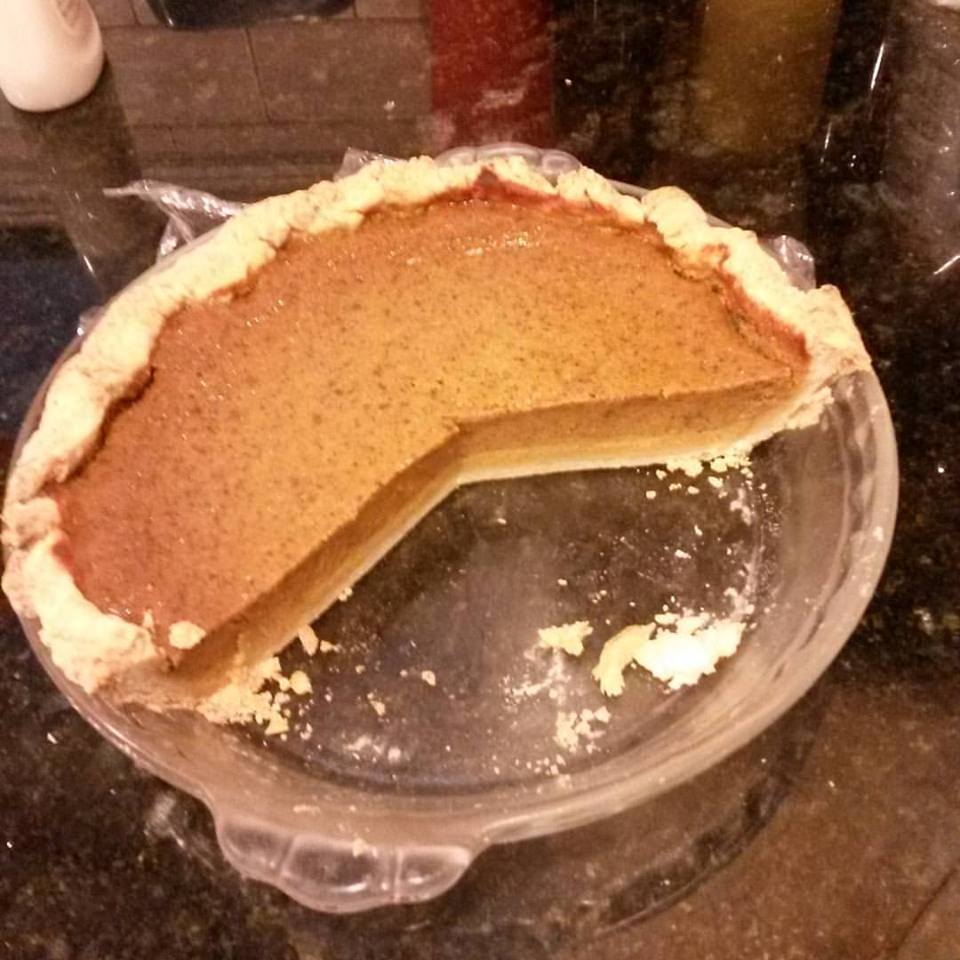
I make a wicked pumpkin pie, and the basic recipe works well with sweet potato or any similar filling.
Pumpkin pie is basically a vegetable and spice flavoured custard in a pie crust. You bake it in a moderate oven (375 F, 205 C) until it sets. Then you eat it (at least if you can get there before your family’s pie monster finishes it).
I’m going to give my recipe in the order that is easiest to do, which means start with the crust, make the custard, roll out the crust, put the custard in the pie and bake it.
Pie crust step 1
2 cups plain flour
1 stick margarine (1/4 pound or so)
1 tablespoon sugar (for a sweet pie, omit for meat pies)
1 teaspoon salt
Work the margarine into the flour, sugar and salt. I use a mixer, but forks and pastry knives are almost as easy. It should be coarse – sort of like corn meal- possibly with a few small chunks of the margarine left.
Put it in a bowl in the freezer to chill and rest.
The filling
This is basically the same as most cans of pumpkin have on the back, but with a minor twist.
1 can pumpkin (1 lb per pie, don’t bother with the “pie filling”) The equivalent is about 1 1/2 cups mashed cooked pumpkin or sweet potato.
3 eggs
1 can condensed milk (about 1 cup)
1 tablespoon corn starch – this helps the custard to set. You won’t find this on the standard recipe.
1 cup sugar
1 teaspoon salt
1 teaspoon ground cinnamon
1/2 teaspoon ground ginger
1/2 teaspoon ground allspice
Mix the eggs, sugar, salt, corn starch and spices. It should be a creamy yellowish mixture. Add the condensed milk and mix thoroughly. Finally add the pumpkin and mix. Set aside.
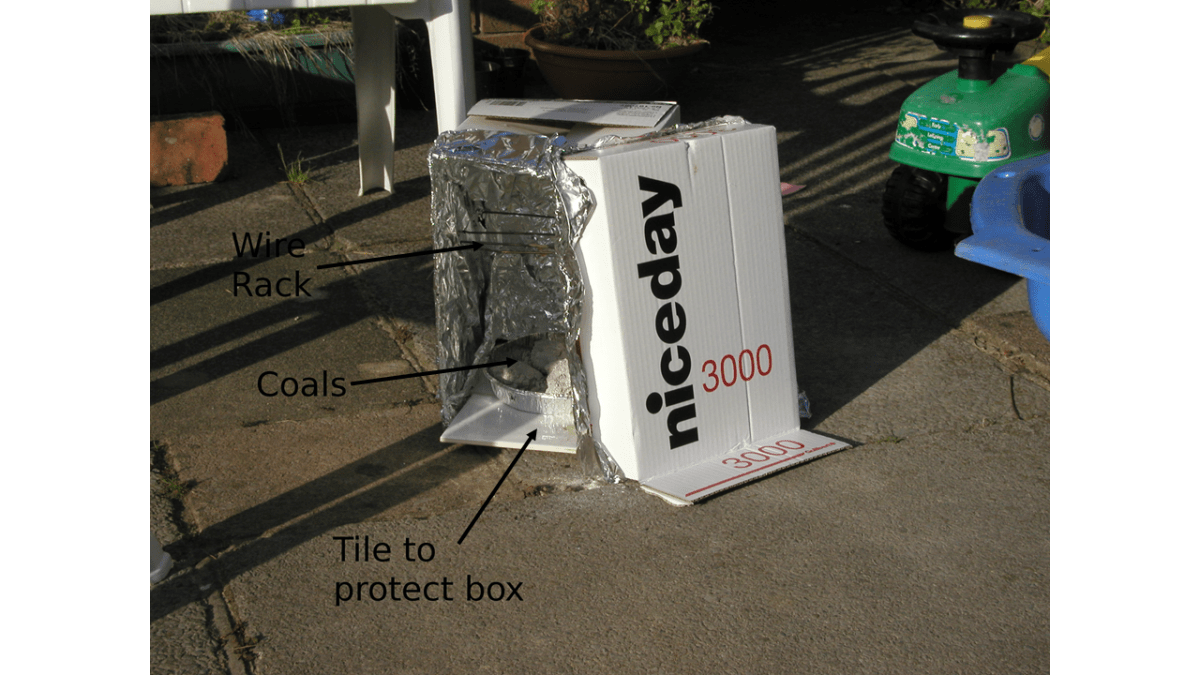
Baking in a box. Take moderate-sized box, we usually used one the size used to deliver copier paper came in (24cm x 24cm x 48cm or so). Line the inside of the box and the lid with aluminium foil (staples are a good way to attach it to the lid.) Put some stones or a tile on the bottom, both to hold down the box and to protect it from the coals. Run a few coat-hanger wires through about 2/3 of the way up to form a rack.
Light charcoal (this needs adult help or supervision), putting about 10 briquettes in an pan. The pan goes in the bottom of the box. When the lid is on the box, the air inside it will get to about 300-350 F (150-200C) which is well below the ignition temperature of paper, but more than hot enough to bake with. A small tray with cookies or biscuits can go on the rack and after a few minutes will be baked. Since the temperature depends on how well the lid seals (there has to be some leakage to keep the coals burning, but this isn’t usually a problem), the exact baking time and temperature will vary.
Still it’s good fun, requires little advance preparation, and can be put together by 8-11 year old children without much assistance from mom or dad. Beats an “easy-bake” any day.
This is our traditional way of preparing the thanksgiving bird.
Stuffing for a smallish turkey:
one loaf white bread
one pound cheap fatty pork sausage
four or five stalks of celery
one or two onions
salt, pepper, thyme, sage to taste
two eggs
Cook the sausage, crumbled up in small bits. Chop and add the onions and celery. Cook to sweat that. It should be limp but not browned. Add about 1 teaspoon dried sage and 2 teaspoons dried thyme.
It should look something like this:
I would taste a small amount, and possibly add pepper (< 1 teaspoon) and maybe salt (there is usually plenty in the sausage). I typically use “lite” salt that has potassium chloride because I like the extra potassium in my diet.
While it’s cooking clean the bird, remembering to remove the neck and gizzards (use them to make gravy).
Salt both the outside and inside of the bird. (The red dot is from a thermometer plug that’s common in the USA.) Find a pan which will fit it.
Coarsely cut the bread into cubes and add to the mixture. Add the eggs to it and mix.
I will typically deglaze the pan by putting about 1/2 cup of water in it and reducing that to about half the volume. It removes the brown, tasty residue from the pan and converts it into a brown, tasty liquid that gets added to the stuffing.
Stuff the bird. Cover in foil and bake at a moderate heat (300F, 150C) until done. I usually remove the foil about an hour before serving to let it color up.
This is a surprisingly simple recipe that works both on the stove top, and even more amazingly, with period cooking gear, and completely unbelievably with tenderfoot/webelos scouts (did I ever mention I’m a scout leader and adult trainer?).
I’m going to give two variations, the “fail safe” one that you can eat uncooked, and the somewhat nicer one that you can cook when you know what you’re doing.
The recipe
fail safe
one or two onions, cut up
two or three carrots, cut thin
Saute, what the heck, fry until they start to brown. Use oil in the bottom of your dutch oven. (Hint, dutch ovens can sit on a camp stove. ‘Nuff said.)
Pour in:
two cans condensed cream of chicken soup. Plus the water they need.
two cans precooked chicken (pouches are nice too).
a grasshopper and some wood ash (not really)
Cover with an unrolled package of crescent rolls.
Bake until the rolls are done and the soup is bubbling.
The Right Way
one or two onions, cut up
two or three carrots, cut thin
Saute, what the heck, fry until they start to brown. Remove from the heat and add 3 cutup chicken breasts (or as they would have said in Victorian times, ‘white meat’).
Cook the meat until the until it’s more or less done. There will be a surprising amount of water coming out of the meat, and you want to get shot of it. When it’s nearly done, return the onions and carrots, add about 1 cup of chicken stock and a tablespoon of corn starch. Boil to reduce. Then put in a baking dish – or dutch oven, but I’m going to show a picture in a baking dish.
Crust
You could use the crescent rolls, but where’s the fun in that?
One cup ‘type L’ biscuit mix (self-rising flour with a hard shortening rubbed in)
quarter cup (more or less) milk.
Mix then roll out to about 1/4 inch. Or whatever it takes to make it cover the dish. Cover the filling and bake. (400F or 225C 20 minutes, until the crust is done). This is about as close as a Yank can come to the suet dumping crust my English sister-in-law makes.
Eat and enjoy. Goes well with Boone’s farm. Unless you’re scouting, when it goes well with lemonade.
Christmas Cake is one of our family traditions, brought over from the “Old Country.” Well not so old, as we have current connections to England. It’s a solid good Fruitcake. By English standards, we’re too late. Should have set this up a year ago for proper aging.
In any case here’s the recipe:
Cream 2/3 cup butter or margerine. Add 2 cups sugar and 2 tablespoons molasses. Cream.
Add 5 eggs, one at a time. Then turn the mixer up and cream the lot.
It should look like this. Then add:
4 cups plain flour.
1 tablespoon baking powder
1 teaspoon salt
1/2 cup brandy, doesn’t have to be the best grade. VS is fine.
Add a couple of pounds of candied peel, a cup of raisins and a pound of candied cherries.
After mixing, it will be rather stiff. You’ll need to stir it with a spoon. Traditionally everyone in the house should take a turn giving it a stir.
Then put it in a greased springform pan. The beer can is for scale.
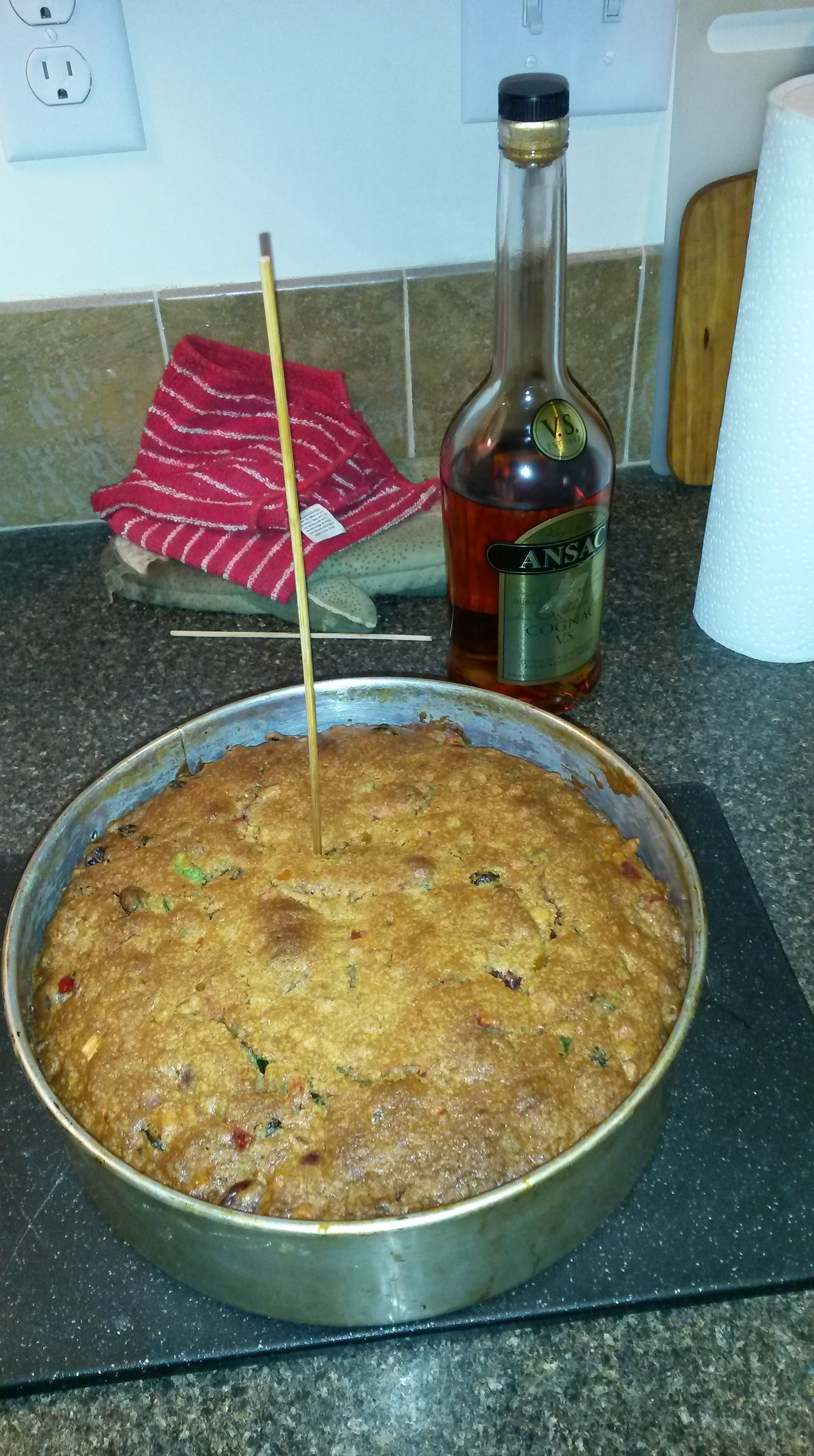
Bake at 350F (200C) until done. It might take 1-2 hours or more. I often leave it overnight, after turning the oven off. It should look like this:
Poke holes in it, and then “feed it” with about 1/2 cup of brandy. Cover it with foil and store in a cool, dark place to mature. I’ll feed the cake every two weeks or so until Christmas.
Carnitas are a Mexican staple, actually “men’s” food, that are surprisingly easy to make. They’re also dashed good, either prepared in the home or on a campout.
The essential ingredient isn’t food. It’s a cast iron, unglazed dutch oven. There’s a whole mythology about curing these (some other post). However, as long as you don’t use soap or detergent on them, keep them dry and oiled, and generally don’t abuse them too much, they’ll serve for many years. The black layer is an iron oxide (not hydroxide or rust) that is relatively non-reactive with the water and sugars in the food. Hence things tend not to stick.
Enough chemistry, here’s the recipe:
Cut boneless pork butt or similar slightly fatty pork into large (2-3 inch, 5-6 cm) chunks. Remove any obviously nasty bits, but don’t be too neat.
Flour the meat in a mixture of wheat flour (plain flour) with oregano, ground chilli pepper (NOT chilli powder which has cumin in it). The meat can be frozen at this step for later use. I used chipolte for this batch, but only because I was out of the powdered pepper from my last trip to New Mexico. Typically for a cup of flour, I’ll use a tablespoon of both oregano and chilli, but your mileage may vary.
Place a layer of oil in the bottom of the dutch oven (or 1/2 stick of vegetable shortening, or a similar amount of Lard (authentic)). The idea is to have enough fat on the bottom to coat it so that the meat is greased before the fat from it cooks out.
Indoors: Bake in a 350 degree oven for 2-3 hours. The pork will be very tender when done. You should turn the meat once or twice during this time.
Outdoors: Use charcoal briquettes, about 8 beneath and 8-12 on top. Rotate the dutch oven about 90 degrees every 15 minutes, and counter rotate the lid about the same amount. Add charcoal as needed. You don’t want it too hot, but you need it to cook.
We served this with tortillas, fresh salsa, lettuce and yogurt (out of sour cream). Oh, and hot peppers.
Dark on top, light underneath and thoroughly enjoyable.
This is an unusual drink idea, and one that actually works. Not quite ‘Lager and Lime,’ but much better.
We used a milk stout rather than the original Guinness, because a) the store was out of Guinness, and b) it’s nicer. Any dark beer will do, and lactose-intolerant people probably shouldn’t use a milk stout.
Stout and cider are about the same density, so layering them is rather difficult. Except if you know the trick. You need to increase the density of the cider. Bar tenders probably do this with ‘neutral syrup’ (i.e. a dense sucrose solution) or even (gag) corn syrup. We used honey. Much better. You could use table sugar, but be prepared to lose most of the carbonation because all those little crystals will nucleate bubbling.
So, without further ado, here’s how to make them.
mix 1 teaspoon of honey with about 1/3 bottle of cider. We did this with a single wooden chopstick. Save the chopstick because you’ll need it for step 2.
Use the chopstick to pour a layer of stout over the cider. Put one end of the chopstick just above the cider and slowly pour the stout down it. (just like you did with solutions in chem lab. Didn’t take chem lab? You missed something worth the time). As the amount of stout in the glass increases, gradually raise the stick keeping it out of the solution. The middle glass in the picture shows what happens when you rush it, so don’t.
Not sure if this will work when I get back to the land of the free but it works well in the UK. My family was getting their fix of sausage, bacon, and black pudding (They’re different over here). The trouble was how to accompany them. Irish soda bread would be great, but
a) we didn’t have any baking soda, and
2) we didn’t have any buttermilk.
What we had was self-raising flour (coarser ground and a different wheat from the US), Greek yogurt and the ability to improvise.
Preheat the oven to 200C (figure this out yourself if you want to use irrational units – but 350F would be a good guess).
While the oven is heating mix and then kneed gently:
2 cups (more or less) or about 250 grams of self-rising flour. In the USA, use plain flour and add a tablespoon of baking powder. Self rising flour in the USA is very salty and a touch bitter, nasty stuff.
1 tsp salt
100g +- of Greek Yogurt. (about a cup, you can mix in a little milk if it’s too solid)
This should form a dampish dough. You may need to add some water, or flour, but the dough should hold together and not be sticky.
Put it on a floured baking sheet, and cut a cross in the top. It should look something like this:
After about 1/2 hour in the hot oven, it will look like this:
It will also sound hollow when you tap it. (Much like yeast bread). It goes very well with bitter, sausage and carrots. It can be a bit tricky, and will sound hollow when slightly underdone, so if you’re not sure wait a few minutes.
I “re-purposed” an old post for this. Here’s what it looks like in the USA
This recipe would work as a “damper” bread and bake well in a Dutch oven.







 R. Harrison, Creative Enterprises